
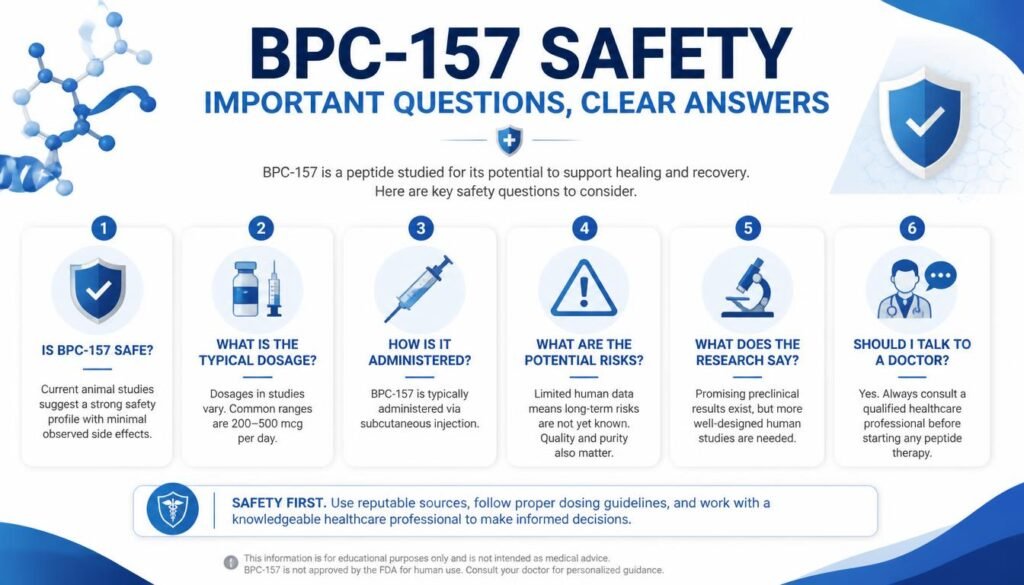
Important safety note: BPC-157 is an experimental peptide and is not an FDA-approved human medicine. There is no validated standard injection dose or approved self-injection method for BPC-157. Because of limited human safety data and concerns about product quality, a healthcare professional should guide any decision about its use.
Table of Contents
Introduction
Many people search for how to inject BPC-157 because they have seen it discussed online for recovery, injuries, inflammation, or other health goals.
The important point is that BPC-157 is not an FDA-approved treatment for human use. The FDA says there is limited safety information for proposed routes of administration and has raised concerns about immune reactions and problems with peptide quality and characterization.
That means online injection guides can give a false sense of safety. There is currently no well-established, FDA-approved BPC-157 injection dose, schedule, or self-injection protocol that beginners can safely follow.
This guide explains what BPC-157 is, why people look for injection information, what the known risks are, and what safer steps to take before considering an injectable peptide.
What Is BPC-157?
BPC-157 stands for Body Protection Compound 157. It is a synthetic peptide that has mainly been studied in laboratory and animal research.
Researchers have investigated BPC-157 for several possible biological effects, including tissue repair and other processes involved in healing. However, results from animal or laboratory studies do not prove that the same benefits or safety exist in humans.
A recent review of the available research noted that BPC-157 still has major development barriers, including limited human data, no validated dosing regimen, and no completed Phase II clinical trial.
So, when someone searches for how to inject BPC-157, it is important to separate online claims from proven medical evidence.
Is BPC-157 a normal medication?
No.
BPC-157 is not the same as an FDA-approved medicine with a well-established label, dosing instructions, warnings, and approved injection technique.
The FDA’s 2026 review of BPC-157-related substances found insufficient information about their safety profile, immunogenicity risks, and effectiveness for the condition reviewed. The agency’s conclusion weighed against placing BPC-157 substances on the 503A bulk drug substances list.
How Does BPC-157 Work?
Scientists are still studying exactly how BPC-157 may affect the body.
Most of the evidence comes from preclinical research, meaning laboratory and animal studies. These studies can help scientists understand possible biological effects, but they are an early step in medical research.
Human evidence remains limited.
A small 2025 pilot study looked at intravenous BPC-157 in only two healthy adults. The participants tolerated the infusions without reported side effects, but the study was extremely small, and its authors said more research is needed to confirm safety.
This distinction matters.
A small early study cannot establish that a product is safe for everyone, nor can it establish a standard dose or prove that it treats a particular medical condition.
Why Do People Want to Inject BPC-157?
People commonly search for BPC-157 injections because of claims involving:
- Muscle recovery
- Tendon injuries
- Joint problems
- Tissue repair
- Inflammation
- Wound healing
- Exercise recovery
However, these are areas of interest rather than established reasons for routine BPC-157 treatment.
The FDA’s 2026 advisory material specifically noted that there was insufficient evidence to determine the effectiveness of BPC-157-related substances for the medical use it reviewed.
That is why it is risky to treat internet testimonials as proof.
Someone may report feeling better after using BPC-157, but that personal experience does not establish how effective the peptide is, what caused the improvement, or whether the same result would happen in another person.
How to Inject BPC-157 Safely
This is where beginners should be especially careful.
There is no validated general-purpose BPC-157 self-injection protocol that can safely be recommended to the public.
Because BPC-157 is experimental and not an FDA-approved human medicine, giving a generic recipe for reconstitution, dose, needle size, injection location, frequency, or injection volume could encourage unsafe use.
Instead, anyone considering BPC-157 should start with a qualified healthcare professional who can review:
- Why the peptide is being considered
- Whether there is a proven treatment for the underlying problem
- The source and quality of the product
- The actual formulation
- Potential interactions
- Relevant medical history
- Appropriate monitoring
- Whether treatment should be avoided altogether
What if a clinician has prescribed or supplied an injectable product?
Follow the specific instructions provided by the prescribing clinician and dispensing pharmacy.
Do not replace those instructions with a generic online BPC-157 dosing or injection guide.
The exact product matters because concentration, formulation, storage requirements, labeling, and administration instructions can differ.
Why a Step-by-Step BPC-157 Injection Guide Can Be Unsafe
Many online pages provide instructions such as:
- Mix the peptide with a specific amount of bacteriostatic water.
- Draw a particular number of insulin-syringe units.
- Inject under the skin.
- Repeat on a certain schedule.
The problem is that these numbers can look medically precise without being backed by an approved dosing standard.
For BPC-157, there is no established FDA-approved regimen that supports such a universal recipe.
A small change in concentration can also change the amount of peptide delivered. This makes copying instructions from another person’s vial particularly risky.
Concentration is not the same as dose
This is an important concept for beginners.
Concentration describes how much substance is present in a particular volume.
Dose describes how much of the substance a person actually receives.
For example, two products may have different concentrations even though their labels use the same total amount of peptide. A syringe marking alone does not tell you that the amount is medically appropriate.
That is one reason a healthcare professional should determine the correct instructions for an actual prescribed product.
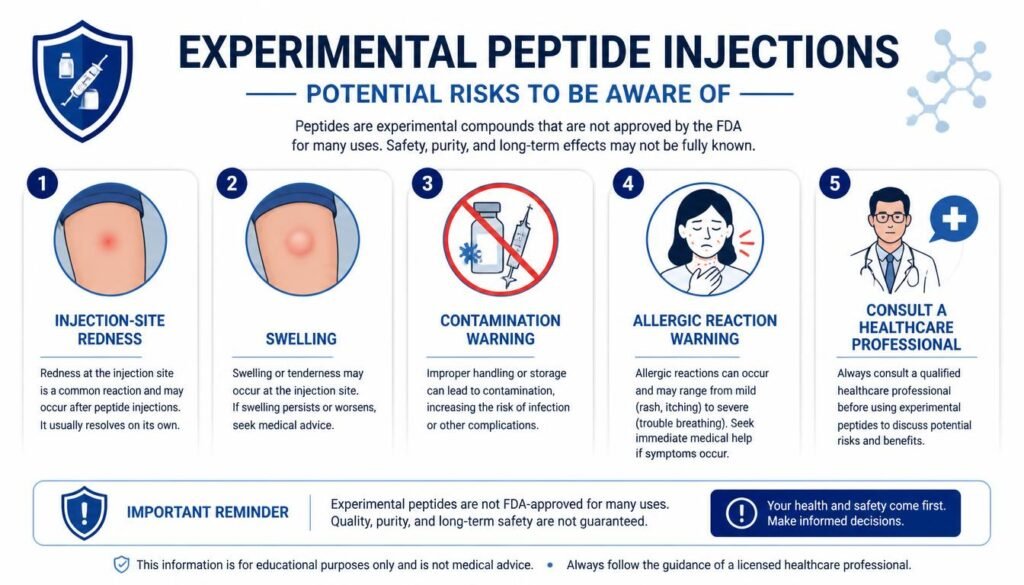
BPC-157 Injection Risks
BPC-157 carries two different groups of concerns: the peptide itself and the act of injecting a non approved product.
1. Limited human safety information
The FDA states that it has identified no or only limited safety-related information for the proposed routes of administration of BPC-157.
This means there is not enough high-quality evidence to confidently predict all short-term and long-term risks.
2. Immune reactions
The FDA has raised concerns about potential immunogenicity, which means a product may trigger an unwanted immune response. The agency has also noted concerns related to peptide impurities and difficulties with characterizing the active ingredient.
3. Product quality
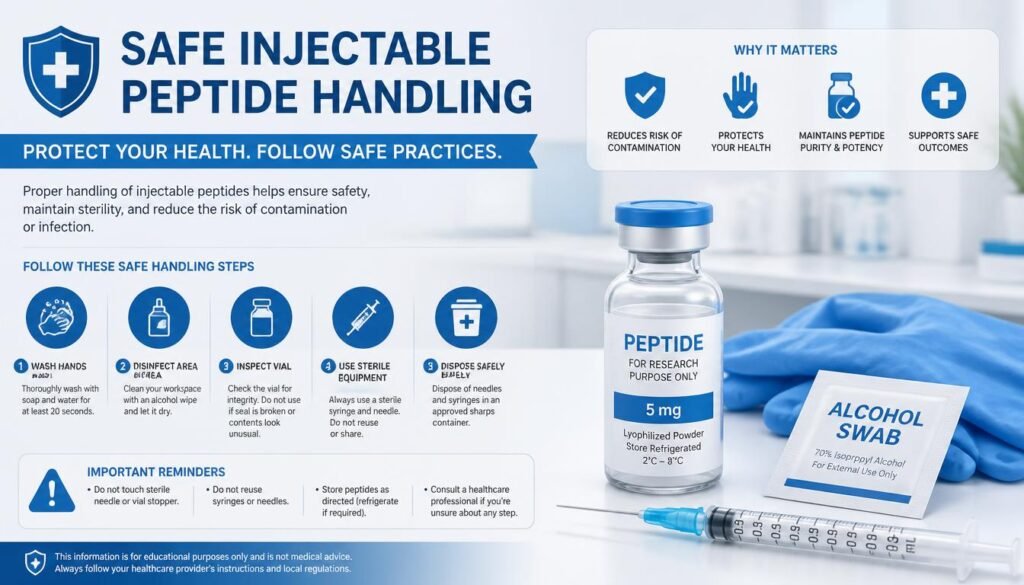
An injectable product needs a high level of quality and sterility.
The FDA warns that compounded drugs can have problems such as contamination or incorrect amounts of active ingredients. Those problems can cause serious injury.
This is especially important when buying peptides from unknown online sellers.
A label that says “research use only” does not turn a product into an approved human medicine.
4. Injection-site problems
Any injection can cause local problems such as pain, redness, swelling, or irritation.
In FDA-reviewed adverse-event reports involving BPC-157 injections, one report described redness and swelling around the injection site for nine days. Other reports described shortness of breath and skin or gum pigmentation changes. FDA also noted that it could not determine whether BPC-157 caused these events because of limited information and other possible factors.
These reports do not prove that BPC-157 caused every event. They do show why safety monitoring matters.
5. Infection
An injection can introduce bacteria into the body when sterile practices fail.
This can lead to a local infection and, in severe cases, a serious systemic infection.
The FDA has repeatedly highlighted the risks associated with poor-quality compounded drugs, including contamination.
Common Mistakes Beginners Should Avoid
When people search how to inject BPC-157, they may come across instructions that make the process seem simple.
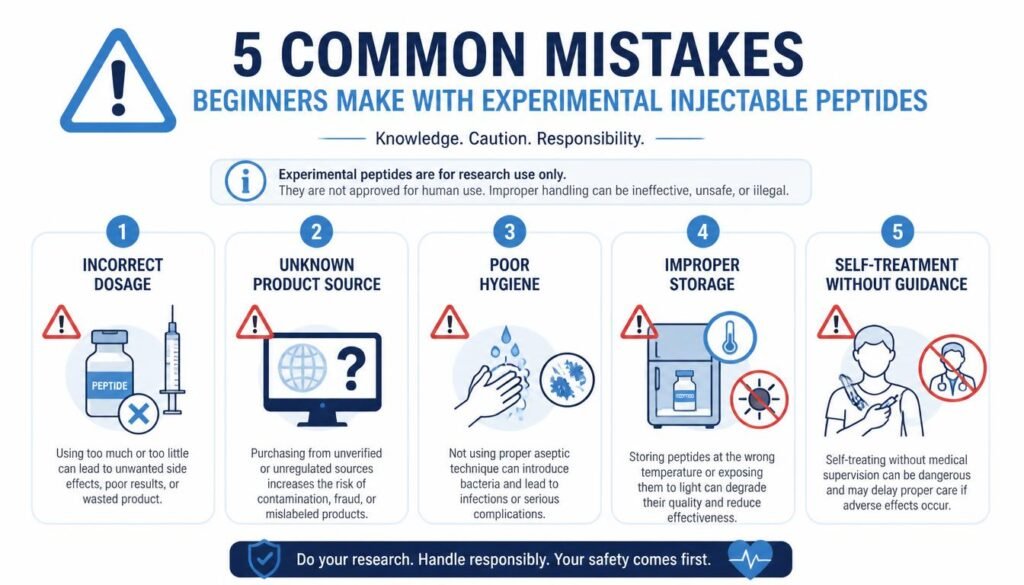
Some common mistakes include the following.
Buying an unknown product online
The source matters.
A product from an unknown seller may not contain the amount stated on its label. It may also have contamination or purity problems.
Copying another person’s dose
A dose that someone says they used online is not a personalized medical recommendation.
People differ in age, health, medicines, medical history, and treatment goals.
Guessing syringe units
Syringe units are not automatically equal to a particular BPC-157 dose.
The relationship depends on the product’s concentration.
Assuming “more” means “better”
There is no established universal BPC-157 dose that proves higher amounts produce better results.
Taking more than an instructed amount can increase risk without providing a proven additional benefit.
Ignoring warning symptoms
Unusual swelling, severe pain, breathing difficulty, widespread rash, fever, or signs of infection deserve prompt medical attention.
Difficulty breathing or other severe symptoms require urgent medical evaluation.
Mixing products without professional advice
Using several experimental peptides or medicines at the same time can make it harder to identify the cause of side effects and can create additional risks.
What to Ask a Healthcare Professional
A good medical conversation should go beyond asking, “How do I inject BPC-157?”
Consider asking:
Is BPC-157 appropriate for my condition?
There may be a proven treatment that has much stronger evidence.
Is the product legitimate and suitable for human use?
The clinician or pharmacist can help assess the source, formulation, labeling, and legal status.
What are the known risks?
Ask about short-term side effects as well as unknown long-term risks.
How should the product be stored and handled?
Storage can affect medication quality, especially for injectable products.
What symptoms should make me stop or seek help?
It is better to know this before starting rather than trying to decide during a possible reaction.
Benefits of BPC-157: What Does the Evidence Show?
The internet often presents BPC-157 as a powerful recovery or healing peptide.
The scientific picture is more limited.
Potential areas of research
Researchers have studied BPC-157 in connection with topics such as:
- Tissue repair
- Gastrointestinal function
- Inflammation
- Musculoskeletal recovery
- Blood vessel and tissue processes
However, much of this research is preclinical.
That means promising laboratory findings should not be treated as proof that an injectable BPC-157 product works as a medical treatment in people.

What do human studies show?
Human evidence is still sparse.
A 2025 pilot study investigated intravenous BPC-157 in just two people. The researchers reported that the participants tolerated the infusions, but the very small sample means the findings cannot establish broad safety.
A 2026 review also described the clinical development of BPC-157 as limited, noting the lack of a validated dosing regimen and the absence of a completed Phase II clinical trial.
So, claims about major healing benefits should be viewed carefully.
Practical Example
Imagine a beginner finds a website selling a BPC-157 vial.
The website says:
“Mix the vial, draw a certain number of units, and inject every day.”
At first, this may sound straightforward.
But several questions remain:
- Is the product actually what the label says?
- Is the product sterile?
- Is the concentration accurate?
- Has the product been approved for human use?
- Is the proposed dose supported by clinical trials?
- Is BPC-157 even the right treatment for the person’s medical problem?
- Could another medicine provide a safer and better-studied option?
These questions are more important than learning a syringe technique from a random webpage.
The safest approach is to discuss the actual product with a qualified healthcare professional rather than relying on an internet dosing chart.
BPC-157 and Athletes
Athletes should also know that BPC-157 has anti-doping implications.
The U.S. Anti-Doping Agency states that BPC-157 was added to the World Anti-Doping Agency prohibited list under the S0 Unapproved Substances category beginning with the 2022 list.
Therefore, competitive athletes should check current anti-doping rules and speak with their relevant sports medicine or anti-doping organization before using BPC-157.
What About Compounded BPC-157?
Compounded medicines are different from FDA-approved medicines.
The FDA explains that compounded drugs are not FDA-approved and are not reviewed by the agency for safety, effectiveness, and quality before they are marketed.
The FDA’s 2026 work on BPC-157-related bulk substances also highlighted concerns about the substance’s safety profile, immune-response risks, characterization, and effectiveness.
That does not mean every compounded product is automatically unsafe. It does mean consumers should not assume that a compounded product has gone through the same approval process as an FDA-approved medicine.
Frequently Asked Questions
What is BPC-157?
BPC-157 is an experimental synthetic peptide that has mainly been studied in laboratory and animal research. Human evidence remains limited, and it does not have an FDA-approved human therapeutic formulation.
How does BPC-157 work?
Scientists are still studying its biological effects. Much of the evidence comes from preclinical research, so its effects in humans are not fully established.
How do you inject BPC-157?
There is no FDA-approved general self-injection protocol for BPC-157. Because the product is experimental and human safety data are limited, a healthcare professional should provide product-specific administration instructions rather than relying on a generic online guide.
Is BPC-157 safe to inject?
Its safety has not been established well enough for a universal answer. The FDA has specifically cited limited safety information and potential concerns involving immunogenicity and peptide impurities.
What is the best BPC-157 injection dose?
There is no validated standard BPC-157 injection dose for general human use. Online dosing charts should not be treated as medical prescribing instructions.
Can I inject BPC-157 myself?
Self-injecting an experimental peptide without appropriate medical guidance can create risks related to dosing, product quality, sterility, and adverse reactions. A qualified healthcare professional should determine whether use is appropriate and provide instructions for any legitimately prescribed product.
How much bacteriostatic water should be used with BPC-157?
There is no single medically validated amount that applies to all BPC-157 products. The correct preparation depends on the specific formulation and instructions supplied by the responsible clinician or pharmacy.
How many units of BPC-157 should I draw into an insulin syringe?
A syringe unit is a volume measurement, not a universal BPC-157 dose. The amount of peptide in that volume depends on concentration. Do not copy syringe-unit instructions from another product or person.
Where should BPC-157 be injected?
Online sources may describe different injection routes or sites, but there is no universally approved BPC-157 injection site for self-use. The appropriate route and administration method should come from a qualified healthcare professional for the specific product.
Does BPC-157 help with injuries?
BPC-157 has been investigated for tissue and injury-related effects, but strong clinical evidence in humans is still lacking. Preclinical findings do not prove that it is an effective treatment for human injuries.
Is BPC-157 FDA approved?
No. BPC-157 does not have an FDA-approved human drug product. The FDA has also raised concerns about proposed compounded BPC-157 products.
What are possible side effects of BPC-157 injections?
Potential concerns include injection-site reactions and other adverse effects, but the complete safety profile is not known. FDA-reviewed reports have included injection-site swelling and redness, shortness of breath, and pigment changes, although causality was not established for those reports.
Is BPC-157 legal for athletes?
Competitive athletes need to be careful. BPC-157 is listed as an unapproved substance under the WADA prohibited list, according to USADA.
A Safer Way to Approach BPC-157
For beginners, the best starting point is not a syringe.
Start with the medical problem you are trying to solve.
For example, someone searching for BPC-157 because of a tendon injury may need a proper diagnosis first. Pain can come from many different conditions, and the right treatment depends on the cause.
A healthcare professional can help determine whether you need:
- A physical examination
- Imaging
- Physical therapy
- Rest or activity changes
- An approved medicine
- Another evidence-based treatment
This approach helps prevent an experimental peptide from replacing appropriate medical care.
Key Takeaways About How to Inject BPC-157
The most important points are simple.
BPC-157 is experimental. It is not an FDA-approved human treatment.
There is no validated universal injection dose or self-injection protocol.
Human safety evidence is limited. FDA has identified concerns involving immunogenicity, product characterization, and limited safety information.
Product quality matters. Problems with compounded injectable products can include contamination or incorrect potency.
Online dosing instructions are not a substitute for medical advice.
Athletes should check anti-doping rules, because BPC-157 is prohibited under the WADA S0 category.
Conclusion
Searching for how to inject BPC-157 can lead to many simple-looking dosing and injection tutorials. However, the medical evidence does not support treating those guides as a standard treatment protocol.
BPC-157 remains an experimental peptide with limited human safety and effectiveness data. The FDA has raised specific concerns about BPC-157-related compounded substances, including limited safety information, possible immunogenicity, and peptide-quality issues.
For beginners, the safest approach is to avoid guessing the dose, syringe units, mixing amount, injection site, or injection schedule. Discuss the actual product and your medical goal with a qualified healthcare professional.
The key lesson is simple: do not let an online BPC-157 injection guide replace professional medical guidance.