
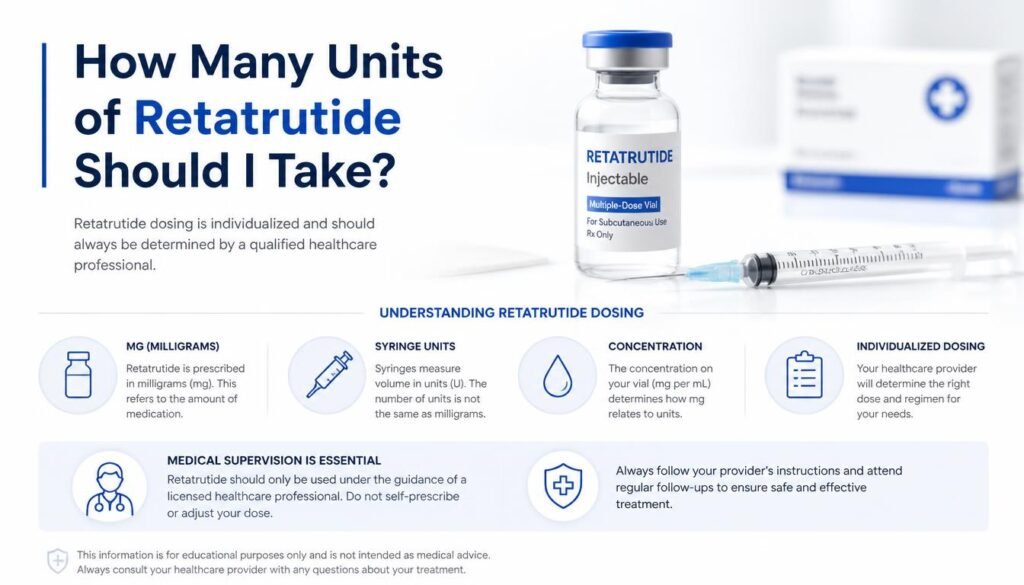
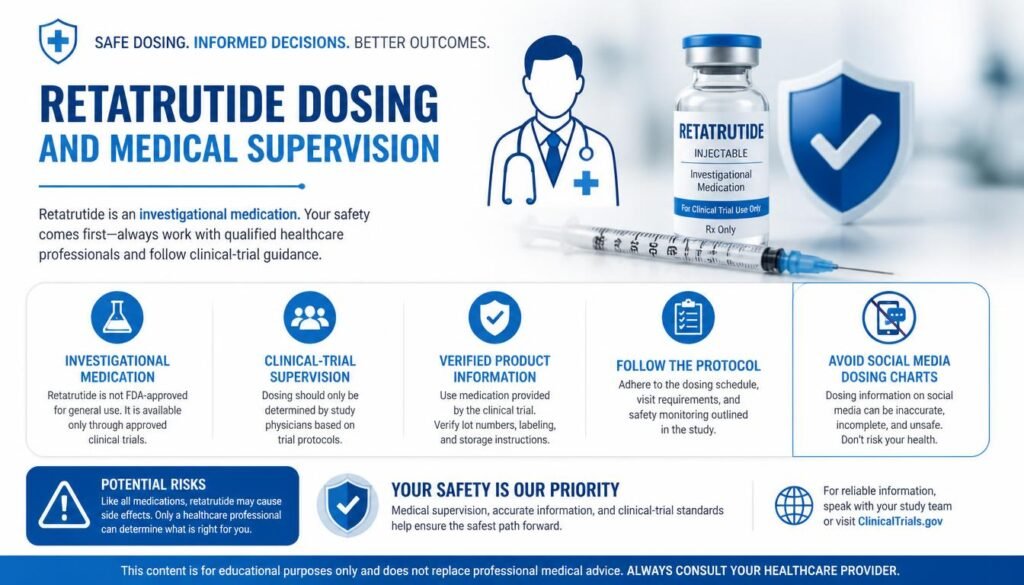
How many units of retatrutide should I take? There is no approved “units” dose that people should use on their own. Retatrutide is still an investigational medication, and it has not been approved by the FDA or another regulatory agency for routine public use. Lilly says retatrutide is currently available only through its clinical trials.
This makes the answer different from medications that come with an approved prescription and a standard syringe dose. Clinical research has studied retatrutide in milligrams (mg), while “units” on an insulin-style syringe measure volume, so a number of units cannot safely be recommended without knowing the exact concentration and formulation and using an unapproved product creates additional uncertainty.
Table of Contents
How many units of retatrutide should I take?
You should not choose a retatrutide dose in syringe units on your own. There is currently no FDA-approved retatrutide dosing schedule for consumers, and products sold outside authorized clinical research may not contain a verified amount of retatrutide.
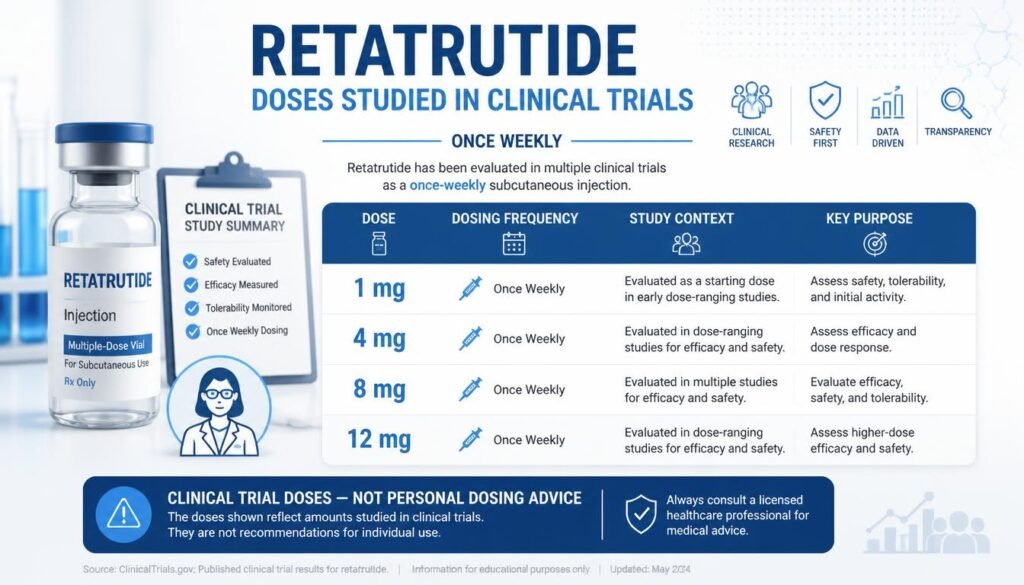
In the published phase 2 obesity trial, researchers studied retatrutide as a once-weekly subcutaneous injection at maintenance doses of 1 mg, 4 mg, 8 mg, and 12 mg. Some participants assigned to higher maintenance doses started with lower doses and gradually increased them during the study.
Those research doses should not be treated as personal dosing instructions. A clinical-trial dose does not automatically tell you how many syringe units to inject from a product you have at home.
Why retatrutide is measured in mg, not simply “units”
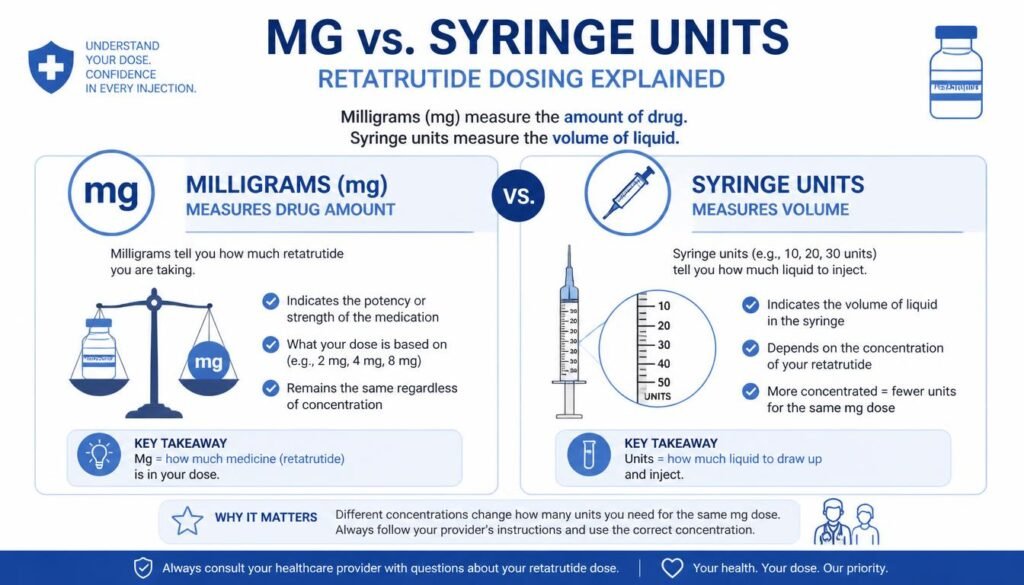
The term milligram (mg) refers to the amount of active drug. Units on a syringe generally refer to a volume marking.
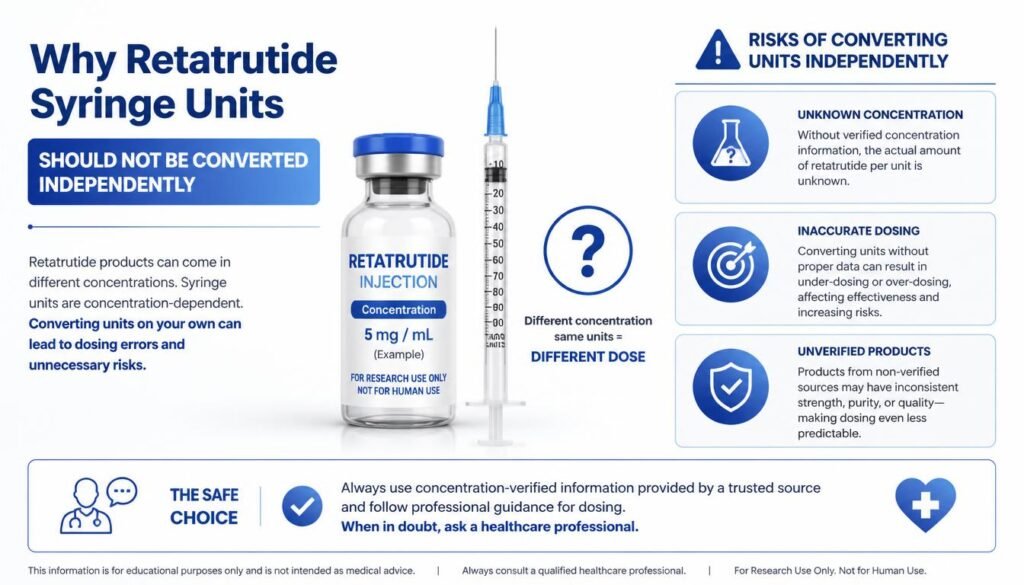
That distinction matters because the same number of syringe units can represent different amounts of drug when the concentration changes.
For example, a hypothetical solution could have one concentration, while another solution could have twice as much drug in the same volume. The syringe markings would not by themselves tell you how much retatrutide you are receiving.
Because retatrutide is not an approved consumer medication, relying on internet “units-to-mg” charts can be especially risky. The concentration, preparation method, and actual contents of an unapproved product may not be reliable.
What retatrutide doses have been studied in clinical trials?
Clinical research has evaluated several retatrutide doses.
| Research maintenance dose | How it was studied |
|---|---|
| 1 mg | Once weekly |
| 4 mg | Once weekly |
| 8 mg | Once weekly |
| 12 mg | Once weekly |
In the phase 2 trial, people assigned to 4 mg, 8 mg, or 12 mg groups could begin with a lower starting dose before gradually increasing toward the assigned maintenance dose. The study reported that gastrointestinal side effects were common and generally became more frequent at higher doses; lower starting doses helped reduce some of these effects.
These numbers describe a research protocol, not a recommendation for self-treatment.
Why you should not convert a retatrutide dose to syringe units yourself
A syringe-unit calculation requires more than knowing a target dose in milligrams.
You would need reliable information about:
- The actual amount of retatrutide in the solution
- The exact concentration
- The total volume
- The type and scale of syringe being used
- Whether the product is authentic and accurately compounded
- The prescribed or research protocol for that specific patient
With an investigational product, those assumptions may not be dependable.
Lilly specifically warns that products claiming to be retatrutide outside its clinical trials may contain unknown ingredients, contaminants, impurities, too much or too little active ingredient, or even the wrong ingredient.
Is there a standard retatrutide dosage for weight loss?
There is no FDA-approved standard retatrutide dosage for weight loss at this time.
Research has produced promising results, but clinical-trial dosing should not be confused with an approved prescribing regimen. In the phase 2 trial, participants received once-weekly retatrutide at different study doses, and the treatment was increased gradually in some groups.
As of July 2026, Lilly still describes retatrutide as an investigational medicine and says it remains in phase 3 clinical trials.
What does “10 units,” “20 units,” or “50 units” of retatrutide mean?
By itself, a statement such as “20 units of retatrutide” does not identify a precise drug dose.
Units on a syringe describe volume, while the actual amount of medicine depends on concentration. Two products could use the same syringe and the same number of units but contain different amounts of active drug.
That is why a unit number copied from a social-media post, online calculator, or forum should not be used as a retatrutide dosing instruction.
Can a retatrutide calculator tell me how many units to inject?
A calculator can perform a mathematical conversion when the concentration is known, but it cannot determine what dose is medically appropriate for you.
More importantly, a calculator cannot verify whether a product marketed as retatrutide is authentic, sterile, correctly prepared, or accurately labeled.
For an investigational medication, the clinical protocol and qualified medical supervision matter more than a simple syringe calculation.
What should I do if I already have a retatrutide vial?
Do not assume that an online dosing chart tells you how much to inject.
Check the product information and discuss it with a qualified healthcare professional or the clinical-trial team supervising your treatment. If the product was obtained outside an authorized clinical trial, that is particularly important because its identity, concentration, purity, and sterility may be uncertain. Lilly advises that retatrutide should not be used outside its sponsored clinical trials.
What are the known side effects of retatrutide?
In the phase 2 trial, the most common adverse events were gastrointestinal, including nausea, diarrhea, vomiting, and constipation. These effects were generally mild to moderate, but they were related to dose, and higher doses produced more gastrointestinal events. The study also observed dose-related increases in heart rate that later declined.
That is one reason researchers used dose escalation rather than simply starting everyone at a high maintenance dose.
If someone experiences severe or concerning symptoms after taking a product sold as retatrutide, they should seek prompt medical attention rather than attempting to correct the dose themselves.
Retatrutide dosing in clinical trials vs. home use
These two situations should not be treated as equivalent.
Clinical trial: Participants receive a defined research product under a protocol, with eligibility criteria, monitoring, documentation, and safety follow-up.
Unapproved product at home: The actual concentration, purity, sterility, and even identity of the substance may be uncertain.
The published research on retatrutide provides useful information about how the drug has been studied, but it does not create an approved self-injection schedule.
What is the safest answer to “how many units of retatrutide should I take?”
The safest answer is: there is currently no approved retatrutide “units” dose for self-use.
Retatrutide remains investigational, and any dosing in an authorized study is determined by the specific clinical-trial protocol. Do not convert published research doses into syringe units and use them as a personal prescription.
This distinction is especially important because a medication dose should be based on a verified drug product and an appropriate medical protocol—not simply on a syringe marking.
FAQ: Retatrutide Units and Dosing
How many units of retatrutide should I take for weight loss?
There is no approved retatrutide unit dose for weight loss. Retatrutide is still investigational and is not approved for routine public use.
How many mg of retatrutide are in one unit?
There is no universal mg-per-unit value. The amount depends on the product’s concentration, and an unapproved retatrutide product may not have a reliably verified concentration.
What retatrutide doses have been studied?
A phase 2 obesity trial studied 1 mg, 4 mg, 8 mg, and 12 mg once weekly, with lower starting doses used for some participants assigned to higher maintenance doses.
Is retatrutide FDA approved?
No. As of July 2026, Lilly states that retatrutide has not been approved by the FDA or any regulatory agency and remains an investigational medicine.
Can I use an insulin syringe for retatrutide?
The syringe itself does not determine the correct medication dose. Using syringe units for an investigational product without verified concentration and professional guidance can result in an incorrect dose.
How often is retatrutide taken in clinical studies?
Published studies have administered retatrutide as a once-weekly subcutaneous injection.
Why do some retatrutide protocols start with a lower dose?
In the phase 2 trial, lower starting doses were used for some higher-dose groups, and the researchers reported that lower starting doses helped mitigate gastrointestinal side effects.
Should I follow retatrutide dosing charts from social media?
No. Social-media charts may mix research doses, different concentrations, and unverified products. A clinical-trial protocol or qualified healthcare professional is a safer source for dosing information.
Conclusion
The question “how many units of retatrutide should I take?” does not have a standard consumer answer because retatrutide is still an investigational medication and is not approved for routine use. Clinical trials have studied once-weekly doses measured in milligrams, but those research doses should not be converted into a personal syringe-unit prescription.
If you are participating in a legitimate retatrutide clinical trial, follow the exact dosing instructions provided by the study team. Avoid relying on online unit calculators or unverified products to determine your injection dose.