
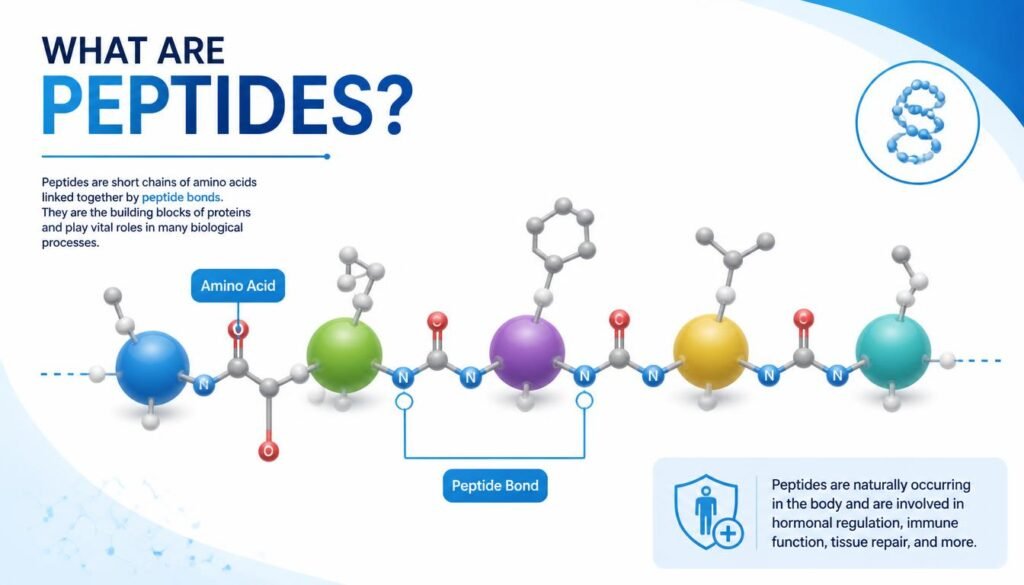
What are peptides? Peptides are short chains of amino acids linked together by peptide bonds. They are smaller than most proteins and play many roles in the human body, including cell signaling, hormone activity, immune responses, and other biological processes.
You may have heard about peptides in discussions about hormones, skincare, fitness, research, or prescription medicines. But the word peptide describes a broad group of molecules, not one specific product or treatment.
This guide explains what peptides are, how they differ from proteins, what they do in the body, where they are used, and why some peptide products require careful medical and regulatory consideration.
Table of Contents
What Are Peptides?
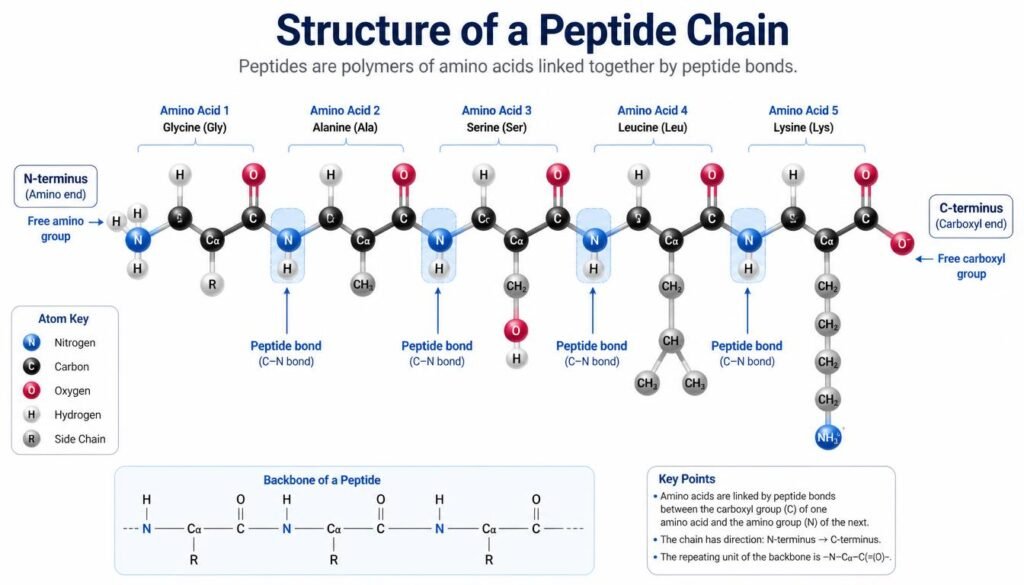
Peptides are molecules made from amino acids joined together in a chain. Amino acids are the basic building blocks used to make peptides and proteins.
A useful way to picture a peptide is as a short string of connected beads. Each bead represents an amino acid, and the order of those amino acids helps determine how the peptide behaves.
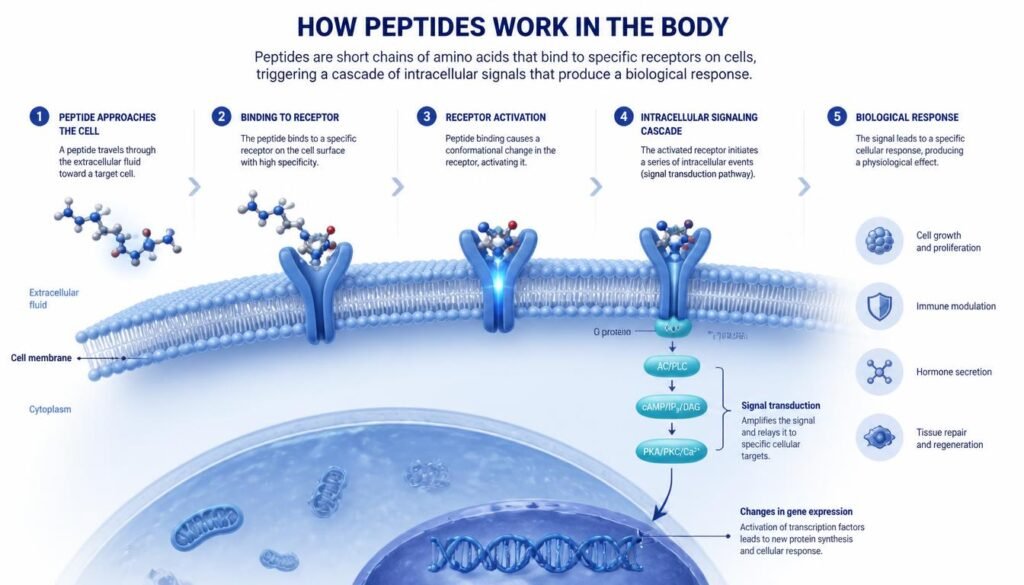
Peptides can occur naturally in the body or be made through laboratory processes. Some act as signaling molecules by interacting with receptors on cells, allowing one part of the body to communicate with another. Peptide hormones and growth factors are examples of peptides involved in cellular signaling.
How Many Amino Acids Are in a Peptide?
There is no single universal cutoff that perfectly separates peptides from proteins in every scientific context. However, NCBI’s MeSH classification describes oligopeptides as roughly 2–12 amino acids and polypeptides as roughly 13 or more, while proteins are generally larger and can fold into complex structures.
In simple terms:
Amino acids → short chains called peptides → longer, more complex chains can form proteins.
How Do Peptides Work in the Body?
Peptides can perform many different jobs because their amino acid sequences and structures vary.
Some peptides act as signals. They can bind to receptors on cells and trigger a biological response. For example, peptide hormones and growth factors can activate receptors and influence processes such as metabolism, growth, and cell activity.
Other peptides have roles in areas such as:
- Hormone signaling
- Immune system activity
- Cell communication
- Metabolism
- Tissue and biological processes
- Regulation of different physiological functions
The exact effect depends on the individual peptide, its structure, its target, and how it interacts with the body.
Peptides vs. Proteins: What Is the Difference?
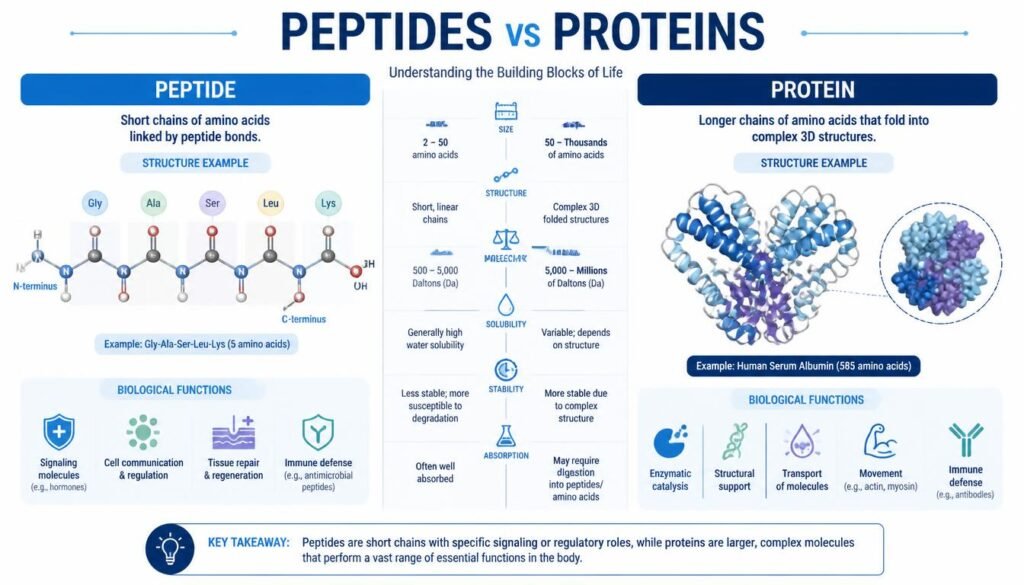
Peptides and proteins are closely related because both are made from amino acids. The main differences involve their size, structure, and biological complexity.
| Feature | Peptides | Proteins |
|---|---|---|
| Building blocks | Amino acids | Amino acids |
| Typical size | Shorter chains | Usually longer chains |
| Structure | Often simpler | Can fold into complex 3D structures |
| Functions | Signaling and many other biological roles | Enzymes, structure, transport, signaling, and more |
| Examples | Peptide hormones and signaling peptides | Hemoglobin, antibodies, enzymes |
A simple comparison is to think of peptides as shorter amino-acid chains, while proteins are generally larger molecules that can form more complicated structures.
However, the boundary between a long peptide and a small protein is not always completely clear. Scientific terminology can vary depending on the context.
Are Peptides Naturally Found in the Human Body?
Yes. The human body naturally produces many peptides.
These naturally occurring peptides can participate in communication between cells and tissues. Some are involved in hormone signaling, while others have roles in immune function and other biological processes.
The fact that a peptide occurs naturally does not automatically mean that every synthetic version or commercially sold peptide is safe. Safety depends on the specific substance, formulation, route of administration, dose, purity, and available clinical evidence.
What Are Peptides Used For?
Peptides have applications in medicine, scientific research, biotechnology, cosmetics, and other fields.
Peptides in Medicine
Some peptide-based medicines are approved for specific medical uses. Modern drug development includes a range of peptide products, and the FDA continues to publish scientific and regulatory guidance concerning peptide drug development.
Approved peptide medicines can have very different purposes. Their uses depend on the specific drug and the condition it is designed to treat.
For example, FDA’s July 2026 guidance work includes peptide products such as semaglutide, liraglutide, glucagon, teriparatide, calcitonin, and pegcetacoplan.
This is an important distinction: “peptide” is a chemical category, not a guarantee that a product is an approved medicine.
Peptides in Scientific Research
Researchers also study peptides to better understand biological signaling, drug development, cell behavior, and potential therapeutic applications.
A peptide may be investigated in laboratory or clinical research without being approved as a treatment for people. Research findings therefore should not automatically be interpreted as proof that a peptide is safe or effective for self-use.
Peptides in Skincare
Some cosmetic products contain peptides as ingredients. These products are marketed for different skin-related purposes, but the evidence and expected results can vary substantially between individual ingredients and formulations.
A skincare peptide should not be confused with a prescription peptide drug or an injectable research compound.
What Are Peptides in Supplements and Fitness Products?
The term “peptide” is commonly used online in connection with bodybuilding, recovery, weight management, wellness, and anti-aging products.
This area requires extra caution because products sold online may not have the same evidence, quality controls, or regulatory status as approved medicines.
A product’s label, marketing claims, or online testimonials do not establish that it is safe or effective.
For compounded drugs, the FDA explains that compounded products are not FDA-approved and are not reviewed by the agency for safety, effectiveness, or quality before marketing. Poor compounding can also lead to contamination, incorrect strength, or other quality problems.
The FDA has also identified specific safety concerns involving some compounded peptide substances, including limited safety information, peptide-related impurities, and possible immunogenicity risks for certain products.
Are All Peptides Safe?
No. Peptides should not be treated as one single class of universally safe substances.
Some peptides are naturally produced by the body. Some are approved medicines that have been studied for specific uses. Others are experimental compounds with limited human safety information.
Safety can depend on several factors, including:
- The exact peptide
- Its purity and formulation
- How it is administered
- The amount used
- A person’s health and medications
- The quality of the product
- The amount of clinical evidence available
For example, the FDA has stated that some compounded peptide substances have limited safety information or potential risks related to immunogenicity and impurities.
That means a peptide should be evaluated individually rather than judged simply by the word “peptide.”
What Is a Peptide Drug?
A peptide drug is a medicine in which the active ingredient is a peptide or peptide-based molecule.
Peptide drugs may be designed to imitate, replace, influence, or interfere with biological signals in the body. Because peptides can interact with specific biological targets, they can be useful in drug development.
The FDA has specific guidance covering clinical pharmacology considerations for peptide drug products, including pharmacokinetics, drug interactions, immunogenicity, and safety considerations.
The key point is that a peptide drug is not the same thing as an unapproved peptide sold online. Regulatory approval and clinical evidence matter.
How Are Peptides Different From Amino Acids?
Amino acids are individual building blocks, while peptides are chains made from those building blocks.
Think of it this way:
One amino acid = one building block
Several linked amino acids = peptide
Longer and more complex amino-acid chains = protein
The amino acid sequence matters because changing the sequence can change the molecule’s structure and biological activity.
Are Peptides the Same as Protein?
No. Peptides and proteins are related, but they are not exactly the same.
Both contain amino acids linked by peptide bonds. Peptides are generally shorter, while proteins tend to be larger and capable of forming more complex three-dimensional structures.
There is also a gray area between the two terms because there is no universally accepted size cutoff that works for every scientific purpose.
What Are Peptides Made Of?
Peptides are made from amino acids connected by peptide bonds.
The sequence of amino acids determines the peptide’s chemical and biological properties. Even a relatively small change in the sequence can alter how a peptide interacts with other molecules.
This is one reason peptide chemistry is important in medicine and biotechnology: researchers can design or modify peptide structures for specific biological targets.
How Are Peptides Made?
Peptides can be produced naturally by living organisms or manufactured using laboratory techniques.
In the body, cells build biological peptides through processes involving genetic information and protein synthesis.
In laboratories, peptides can be produced through chemical or biological methods. Pharmaceutical manufacturing requires additional controls to ensure the final product meets appropriate standards for identity, purity, strength, and quality.
This distinction is especially important for injectable products, because contamination or incorrect product strength can create serious health risks.
Common Misconceptions About Peptides
“All peptides are drugs.”
False. Peptides are a broad class of molecules. Some are natural biological molecules, some are ingredients in products, some are research compounds, and some are active ingredients in approved medicines.
“Natural peptides are always safe.”
Not necessarily. Natural origin does not automatically determine safety. The specific peptide, dose, route, and context still matter.
“If a peptide is sold online, it must be approved.”
Not true. Online availability does not prove regulatory approval, safety, effectiveness, or manufacturing quality.
The FDA has issued warning letters concerning websites marketing unapproved peptide products and has highlighted risks associated with some injectable products.
“Peptides and proteins are completely different.”
They are closely related. Both are made from amino acids, but peptides are generally shorter and proteins are typically larger and more structurally complex.
What Should You Check Before Using a Peptide Product?
Before using a peptide product, especially an injectable or prescription product, consider the evidence behind the specific substance rather than relying on general claims about “peptides.”
Check whether the product is approved for the intended use, whether there is reliable human clinical evidence, who manufactured it, and whether a qualified healthcare professional has recommended it.
Be particularly cautious with products marketed as “research use only” while being promoted for human use. That wording does not make a product appropriate or safe for self-administration.
Frequently Asked Questions About Peptides
What are peptides in simple terms?
Peptides are short chains of amino acids. They occur naturally in the body and can perform roles such as cell signaling and hormone activity.
What do peptides do?
Peptides can perform many different functions. Some act as signaling molecules, while others participate in hormone activity, immune responses, metabolism, and other biological processes.
Are peptides proteins?
Peptides and proteins are both made from amino acids, but peptides are generally shorter. Proteins are usually larger and can form more complex three-dimensional structures.
Are peptides naturally produced by the body?
Yes. The body naturally produces many peptides that help regulate biological processes and communication between cells.
Are peptide medicines FDA-approved?
Some peptide medicines are FDA-approved for specific medical uses. However, not every peptide product on the market is approved. The approval status depends on the exact product and intended use.
Are peptides safe for everyone?
No. Safety varies by peptide, product quality, dose, route of administration, and individual health factors. Some experimental or compounded peptide products have limited safety data.
Are peptides the same as amino acids?
No. Amino acids are individual molecules that can be linked together to form peptides. A peptide is therefore a chain of amino acids.
Why are peptides studied in medicine?
Peptides can interact with specific biological targets, including cell receptors, which makes them useful for studying and influencing biological processes. Some peptide-based medicines have been developed and approved for specific medical conditions.
Conclusion
So, what are peptides? They are short chains of amino acids that play many important roles in biology. Some work as signaling molecules, hormones, or other functional compounds, while certain peptides have been developed into medicines.
Peptides and proteins are closely related, but peptides are generally shorter and less structurally complex. Most importantly, the word “peptide” alone does not tell you whether a product is effective, safe, or medically approved.
When evaluating a peptide product, focus on the specific substance, its intended use, the quality of the product, and the strength of the human evidence behind it. For medical or injectable peptide products, professional medical guidance is the safest approach.