
How to reconstitute peptides depends on the specific peptide product, its formulation, the supplied diluent, and the manufacturer’s instructions. For an approved or pharmacy-dispensed injectable peptide, the safest approach is to follow the product label or pharmacy instructions exactly rather than using a generic mixing formula.
Reconstitution usually means adding a specified sterile liquid to a powdered or lyophilized medication so it becomes a usable solution. The process sounds simple, but the wrong diluent, incorrect amount, poor sterile technique, or improper storage can make an injectable product unsafe.
This guide explains what peptide reconstitution means, how the process generally works, what to check before mixing, common mistakes to avoid, and why many online “peptide mixing charts” should not be treated as universal instructions.
Table of Contents
What Does Peptide Reconstitution Mean?
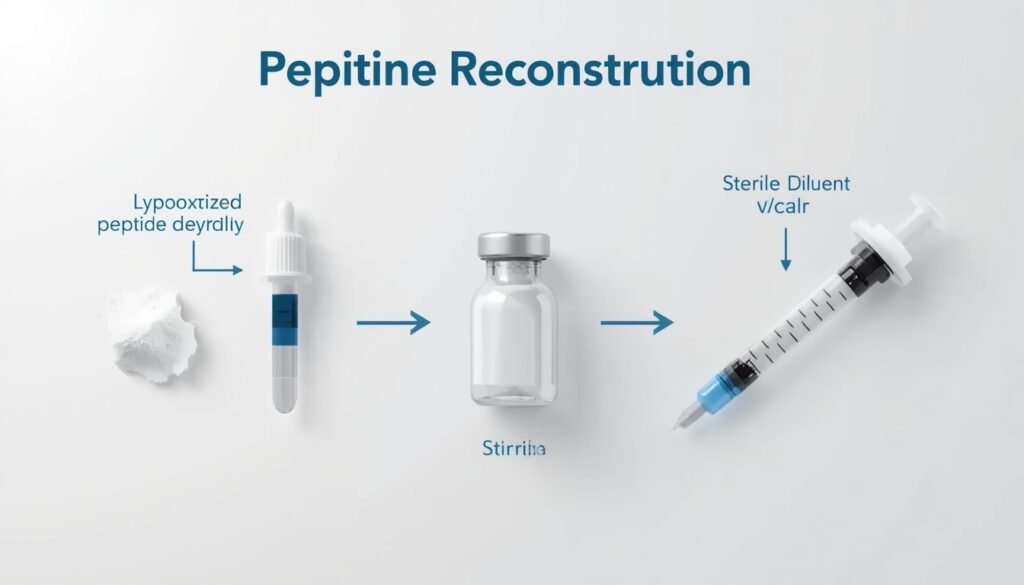
Peptide reconstitution is the process of adding an appropriate sterile diluent to a dry, usually lyophilized, peptide preparation to create a solution suitable for the route specified by the product.
Lyophilized means the product has been freeze-dried to improve stability during storage. Before use, the dried material may need to be dissolved according to the manufacturer’s directions.
The exact reconstitution method is not the same for every peptide. Different products can have different concentrations, diluents, storage requirements, compatibility considerations, and stability after mixing.
For prescription medications, the official product information or dispensing pharmacy should be the primary source of instructions.
How to Reconstitute Peptides Safely
There is no single reconstitution recipe that applies to every peptide. A safe process starts with the specific instructions for the product you actually have.
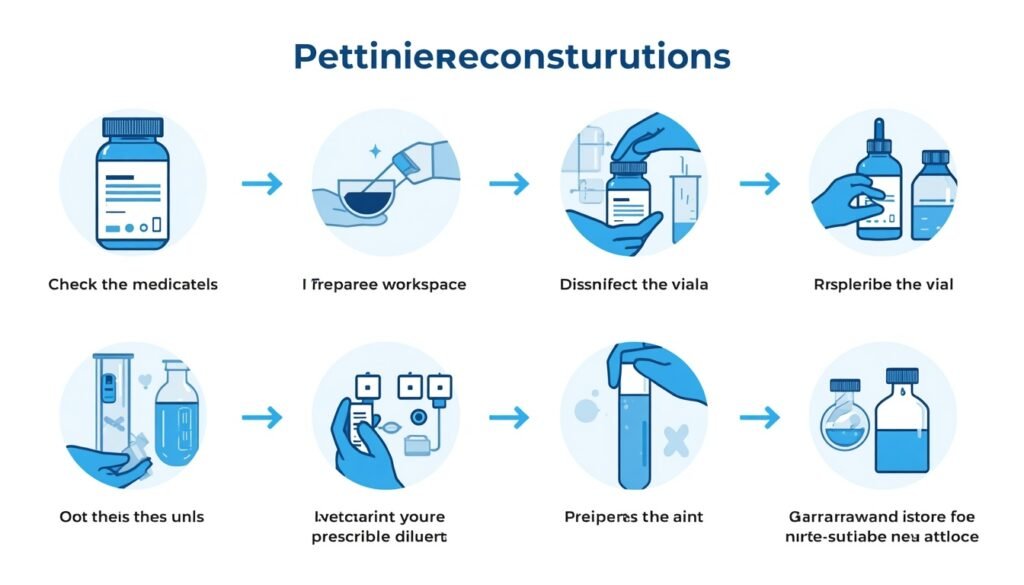
1. Verify the exact product
Before adding anything to a vial, confirm:
- The peptide or medication name
- Strength and vial size
- Route of administration
- Expiration or beyond-use information
- Recommended diluent
- Reconstitution instructions
- Storage requirements after mixing
Do not rely only on the peptide name. Two products with similar names can have different formulations and instructions.
2. Use only the specified diluent
The correct diluent is product-specific.
Depending on the medication, the instructions may specify a particular sterile diluent. Examples can include sterile water for injection or a bacteriostatic preparation, but these liquids are not interchangeable for every medication.
Never assume that a diluent is appropriate simply because it is commonly discussed online. Check the medication’s official instructions or ask the dispensing pharmacist.
3. Prepare a clean work area
Injectable medications require careful infection-control practices.
CDC guidance recommends preparing medications in a designated clean area away from potential contamination sources and using aseptic technique. The vial’s access surface should also be disinfected before entry.
This matters because an injectable product bypasses many of the body’s normal defenses against microorganisms.
4. Follow the product-specific mixing instructions
The manufacturer’s directions should specify how much diluent to use and how the solution should be prepared.
Rather than using a universal peptide mixing calculator, follow the exact instructions for that product. The amount of diluent changes the resulting concentration, so using an arbitrary volume can lead to an incorrect concentration and dosing error.
For example, adding a larger amount of diluent produces a more dilute solution, while adding less produces a more concentrated solution. That does not mean there is one “best” volume for a particular peptide.
5. Mix gently according to the instructions
Many injectable products should be mixed carefully rather than aggressively shaken. The exact handling instructions depend on the formulation.
If the product information tells you to gently swirl, roll, or otherwise mix the vial, follow that method. Do not improvise if the instructions are unclear.
6. Inspect the solution before use
After reconstitution, check the solution according to the product instructions.
Do not use an injectable medication if the solution has an unexpected appearance, contains unusual particles, appears contaminated, or otherwise does not meet the product’s stated specifications.
When in doubt, contact the dispensing pharmacy or healthcare professional instead of trying to “fix” the solution yourself.
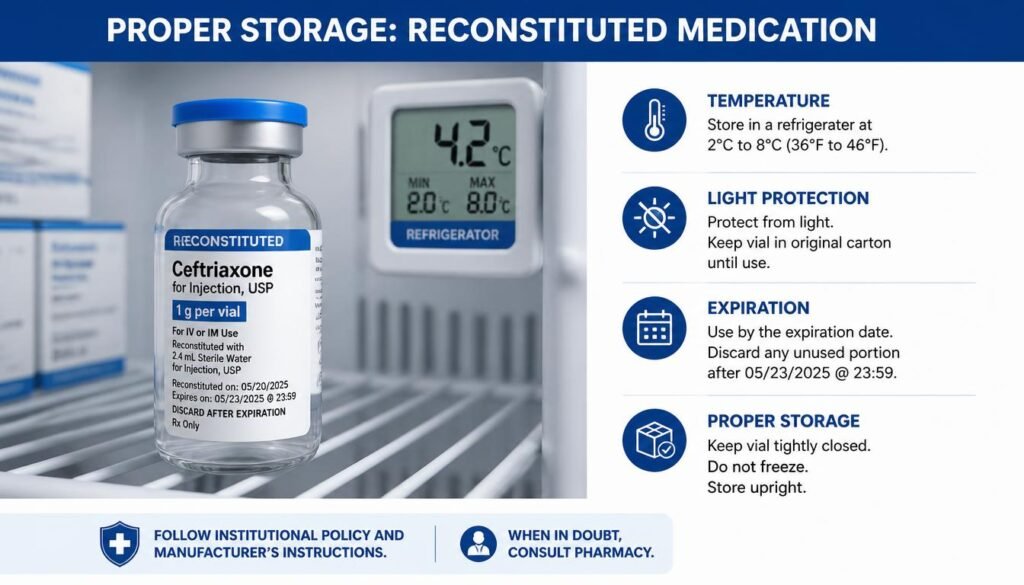
7. Store the reconstituted product correctly
Storage requirements can change after reconstitution.
Some products require refrigeration, while others have different storage conditions. The usable period after mixing can also vary substantially between medications.
The correct storage temperature, light protection, and discard date should come from the product label, package insert, or pharmacy instructions not from a general peptide chart.
Why You Shouldn’t Use a Universal Peptide Reconstitution Chart
A common mistake is assuming that every peptide can be mixed using the same amount of liquid.
That’s not reliable because the final concentration depends on both the amount of peptide in the vial and the volume of diluent added.
For example:
Final concentration = amount of peptide ÷ final solution volume
If a vial contains a specified amount of medication and you change the amount of diluent, the concentration changes as well.
A concentration calculation can be mathematically correct and still be medically inappropriate if the chosen diluent, concentration, storage condition, or product formulation is wrong.
That is why a calculator should not replace the official instructions for a specific medication.
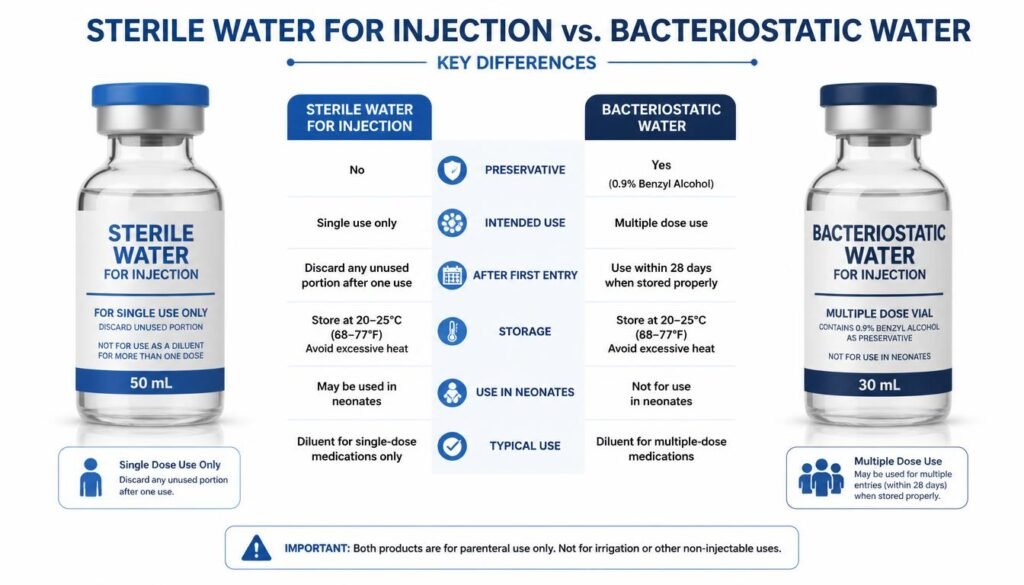
What Is the Difference Between Sterile Water and Bacteriostatic Water?
Sterile water for injection and bacteriostatic water are different products with different characteristics.
Sterile water for injection is a sterile diluent without an antimicrobial preservative.
Bacteriostatic water contains an antimicrobial preservative and is supplied for applications where its labeled use is appropriate.
Neither should automatically be considered the correct diluent for every peptide. The correct choice depends on the specific medication and its labeling or pharmacy directions.
Using the wrong diluent can affect product stability, sterility, compatibility, or safety.
Are “Research Peptides” Safe to Reconstitute at Home?
Extra caution is needed with products sold online as “research peptides,” “research use only,” or similar products.
A product being sold in a vial does not mean it has been reviewed and approved for injection in humans. FDA warns that unapproved and improperly compounded products can have serious quality problems, including contamination and incorrect strength.
FDA has also identified safety concerns involving a number of compounded peptide substances, including risks related to impurities, aggregation, immunogenicity, and limited human safety information.
For that reason, online instructions for reconstituting an unapproved research peptide should not be treated as equivalent to instructions for an FDA-approved medication.
Common Peptide Reconstitution Mistakes
Using the wrong diluent
One of the most important mistakes is choosing a diluent based on an online recommendation instead of the product’s instructions.
Guessing the mixing volume
A vial labeled with a peptide amount does not automatically tell you how much liquid to add. The required volume should come from the specific product instructions.
Shaking the vial aggressively
Some formulations may be sensitive to handling. Use the mixing method specified for the product rather than assuming vigorous shaking is appropriate.
Touching sterile components
Contamination can occur when needles, syringe tips, vial tops, or other sterile components are handled improperly.
CDC recommends aseptic technique and a new sterile needle and syringe whenever medication containers are accessed.
Ignoring storage instructions
A correctly mixed medication can still become unsuitable if it is stored incorrectly or kept longer than the permitted period.
Following an internet “units” chart without checking concentration
Syringe markings are measurements of volume, not automatically measurements of peptide dose.
The actual amount of medication represented by a particular volume depends on the concentration of the reconstituted solution.
How Do You Calculate Peptide Concentration?
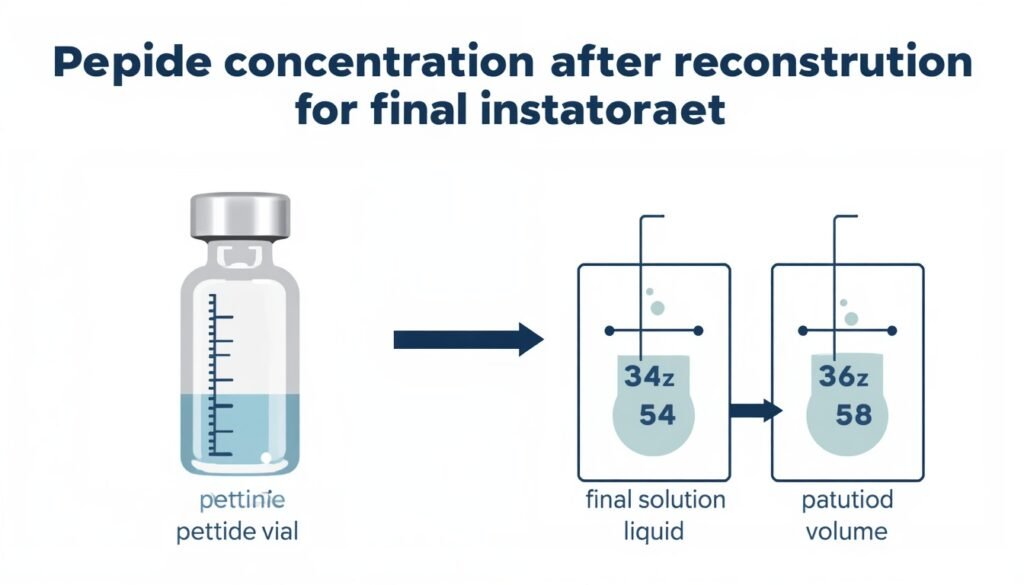
The basic mathematical relationship is:
Concentration = amount of peptide ÷ total solution volume
For example, if a product contains a known amount of peptide and the manufacturer specifies a particular final volume, dividing the peptide amount by that final volume gives the resulting concentration.
However, this calculation only describes the concentration mathematically. It does not determine the medically appropriate dose, diluent, injection volume, storage period, or route of administration.
Those details must come from the product instructions and healthcare professional.
How Long Do Reconstituted Peptides Last?
There is no universal shelf life for a reconstituted peptide.
The usable period depends on the specific product, formulation, diluent, storage conditions, container type, and whether the product is intended for single or multiple use.
For this reason, do not assume that a reconstituted peptide remains usable for a certain number of days simply because another peptide has that storage period.
Always follow the product label, package insert, or pharmacy-provided beyond-use date.
How Should Reconstituted Peptides Be Stored?
Storage conditions are product-specific.
Some medications may require refrigeration, while others have different temperature or light requirements. A pharmacy-dispensed product should include the appropriate storage information.
Keep the vial in its labeled packaging when required and avoid exposing it to conditions that are not permitted by the manufacturer.
When a label and an online source disagree, the labeled product instructions should take priority.
What Should You Do If the Peptide Looks Cloudy or Has Particles?
Do not assume that an unusual appearance is normal.
Check the medication’s official instructions for its expected appearance. If the product looks different from what is described, or if you see unexpected particles, discoloration, or other changes, do not use it until the pharmacy or healthcare professional confirms that it is appropriate.
Trying to filter, remix, or otherwise alter a questionable injectable product can create additional safety risks.
Why Sterile Technique Matters During Reconstitution
Reconstitution of an injectable medication is not just a mixing procedure. It is also a sterile-handling procedure.
Contamination introduced during preparation can potentially lead to serious infection. CDC guidance emphasizes aseptic preparation, disinfecting vial access points, and using new sterile needles and syringes when accessing medication containers.
This is one reason commercially prepared or pharmacy-dispensed products may include detailed preparation instructions that should be followed exactly.
Prescription Peptides vs. Unapproved Peptides
The distinction matters.
| Type | What to rely on |
|---|---|
| FDA-approved prescription medication | Official labeling and pharmacy/healthcare instructions |
| Properly dispensed compounded medication | Pharmacy label and instructions from the prescriber/pharmacist |
| Online “research peptide” | Do not assume it is suitable or approved for human injection |
| Unknown or unlabeled vial | Do not use it based on internet instructions |
FDA states that compounded drugs are not FDA-approved and are not reviewed by the agency for safety, effectiveness, or quality before marketing. Poor-quality compounded drugs can potentially cause serious injury.
A Simple Checklist Before Reconstituting a Peptide
Before preparing an injectable peptide, make sure you know:
- The exact product and strength
- The approved or prescribed route
- The correct diluent
- The required diluent volume
- The approved mixing method
- The expected appearance
- The storage requirements
- The discard or beyond-use date
- The correct administration instructions
If any of these are unclear, ask the dispensing pharmacy or healthcare professional rather than guessing.
Frequently Asked Questions
How to reconstitute peptides safely?
Use the exact instructions supplied with the specific medication. Confirm the correct diluent and volume, use aseptic technique, follow the product’s mixing instructions, and observe its storage and discard requirements.
What liquid do you use to reconstitute peptides?
There is no universal diluent for all peptides. The correct liquid depends on the specific product and its instructions. Some products may specify sterile water for injection or another labeled diluent, while others have different requirements.
Can I use bacteriostatic water for any peptide?
No. Bacteriostatic water should only be used when it is appropriate for the specific medication and permitted by its instructions. Do not assume it is interchangeable with other sterile diluents.
How much bacteriostatic water should I add to a peptide?
There is no safe universal amount. The appropriate volume depends on the exact product, its concentration, formulation, and intended use. Follow the product label or pharmacy instructions rather than a generic online chart.
Does reconstituting a peptide change its concentration?
Yes. The final concentration depends on the amount of peptide and the final volume of solution. Changing the amount of diluent changes the concentration.
How long can a reconstituted peptide stay in the refrigerator?
There is no universal refrigerator storage period. The allowed storage time depends on the individual medication and its formulation. Follow the product label, package insert, or pharmacy-provided instructions.
Can you reconstitute a peptide by shaking it?
Not necessarily. The correct mixing method is product-specific. Follow the instructions supplied with the medication and avoid improvising a mixing technique.
Are research peptides the same as prescription peptides?
No. A research-use product is not automatically an FDA-approved medication for human use. FDA has warned about quality and safety concerns involving various unapproved and compounded peptide products.
Conclusion
Learning how to reconstitute peptides starts with one key principle: there is no universal peptide mixing formula. The correct diluent, volume, handling method, concentration, storage conditions, and discard period depend on the specific product.
For prescription or pharmacy-dispensed medications, use the official instructions and ask the pharmacist or prescriber when anything is unclear. Avoid relying on generic internet charts for unapproved peptide products, especially when the product is intended for injection.
Safe reconstitution is not just about getting the math right. It also requires the correct product information, appropriate sterile technique, and proper storage.