Dilution Ratio Calculator
Calculate the concentrate and water needed for your desired dilution.
Need to find the right amount of concentrate and water for a specific dilution? Our Dilution Ratio Calculator makes dilution ratio calculations quick, simple, and accurate. Enter your dilution ratio and desired final volume to instantly calculate how much concentrate and diluent you need.
Table of Contents
What Is a Dilution Ratio Calculator?
A dilution ratio calculator is a free online tool that helps you calculate the correct amounts needed to create a diluted mixture. It can be used for liquids, cleaning solutions, laboratory mixtures, concentrates, and other applications where a specific ratio is required.
The calculator removes the guesswork from manual math. Whether you need a 1:5 dilution calculator, 1:10 dilution calculator, or 1:100 dilution calculator, you can get an instant result in seconds.
Direct Answer: How Do You Calculate a Dilution Ratio?
To calculate a dilution, first identify the ratio of concentrate to total diluent or mixture, depending on how the ratio is defined. For example, a 1:10 dilution commonly means 1 part concentrate plus 9 parts diluent, creating 10 total parts.
For a simple ratio calculation:
Concentrate = Total Volume ÷ Total Parts
Diluent = Total Volume − Concentrate
Always follow the instructions for your specific product or application because dilution ratios can be defined differently.
How to Use the Dilution Ratio Calculator
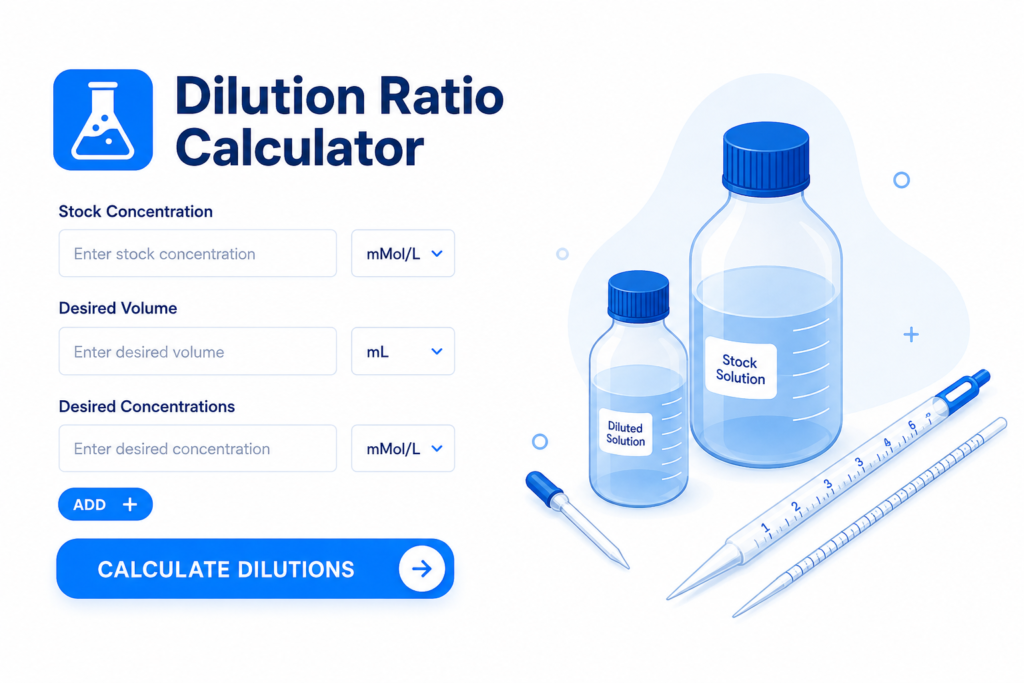
Using this ratio dilution calculator is fast and beginner-friendly.
Step 1: Enter the Dilution Ratio
Enter the required ratio, such as 1:5, 1:10, 1:20, or 1:100.
Step 2: Enter the Desired Final Volume
Choose how much solution you want to make. You can use common units such as milliliters, liters, cups, or gallons, depending on the calculator.
Step 3: Get Your Result
The tool instantly calculates the required amount of concentrate and diluent so you know exactly how much to mix.
This makes dilution ratio calculation easier than calculating the proportions manually.
Dilution Ratio Examples
Here are a few simple examples to show how dilution ratios work.
1:10 Dilution
For a 1:10 dilution, 1 part is concentrate and the remaining 9 parts make up the diluent when interpreting the ratio as 1 part concentrate in 10 total parts.
For a final volume of 1,000 mL:
- Concentrate: 100 mL
- Diluent: 900 mL
- Total mixture: 1,000 mL
1:5 Dilution
For a 1:5 dilution, a 1,000 mL final mixture would contain:
- Concentrate: 200 mL
- Diluent: 800 mL
- Total mixture: 1,000 mL
1:20 Dilution
For a 1 to 20 dilution, a 1,000 mL final mixture would require:
- Concentrate: 50 mL
- Diluent: 950 mL
- Total mixture: 1,000 mL
These examples assume the ratio represents 1 part concentrate in the total number of parts. Always check the product directions before mixing.
Key Features of Our Dilution Ratio Calculator
Our free calculator is designed to make everyday dilution math easier.
- Instant calculations with no complicated formulas
- Supports common ratios such as 1:5, 1:10, 1:20, and 1:100
- Useful for liquid dilution and concentrate mixing
- Simple interface suitable for beginners
- Fast results for small or large quantities
- Helps reduce manual calculation errors
- Works for common volume measurements
Benefits of Using a Dilution Ratio Calculator
Manual dilution calculations can become confusing when you need to scale a mixture from a small bottle to a larger container.
A liquid dilution calculator gives you a simple way to calculate the correct proportions. Instead of repeatedly working through the math, you can enter your values and get the result instantly.
It is especially helpful when preparing multiple batches with the same ratio or converting a ratio to a specific final volume.
Why Use This Dilution Calculator?
A reliable dilution ratio calculation can save time and improve consistency. The calculator is useful for students, professionals, technicians, hobbyists, and anyone who works with products that require dilution.
You can also use it as a liquid ratio calculator when you need to scale a mixture up or down while keeping the same proportion.
For example, the same ratio can be used to prepare 100 mL, 500 mL, 1 liter, or another target volume, provided the ratio is applied correctly.
Dilution Ratio vs. Dilution Percentage
A dilution ratio and dilution percentage are related, but they are not always written or interpreted in the same way.
For example, a 1:10 dilution may be interpreted as 1 part concentrate in 10 total parts, which is equivalent to 10% concentrate by volume under that convention.
A dilution percent calculator can be useful when your instructions are given as a percentage instead of a ratio.
Always check whether a manufacturer or procedure defines a ratio as concentrate:diluent or concentrate:total mixture before converting it.
Common Dilution Ratios
What Does a 1:5 Dilution Mean?
A 1:5 dilution commonly means 1 part concentrate in 5 total parts. For 500 mL of final solution, that would be 100 mL concentrate and 400 mL diluent under this convention.
What Does a 1:10 Dilution Mean?
A 1:10 dilution commonly means 1 part concentrate in 10 total parts. For 1 liter of final solution, that would be 100 mL concentrate and 900 mL diluent.
What Does a 1:20 Dilution Mean?
A 1:20 dilution means 1 part concentrate in 20 total parts under the same convention. For 1 liter, that is 50 mL concentrate and 950 mL diluent.
What Does a 1:100 Dilution Mean?
A 1:100 dilution means 1 part concentrate in 100 total parts. For 1 liter of final solution, that is 10 mL concentrate and 990 mL diluent.
Common Use Cases
A dilute ratio can be useful in many situations where a concentrated liquid must be mixed with another liquid.
Common examples include:
- Cleaning and household concentrates
- Laboratory and educational solutions
- Industrial and commercial liquids
- Gardening and agricultural products
- Automotive and maintenance fluids
- Craft and hobby applications
- Other products with manufacturer-specified mixing ratios
Use the product label or official instructions whenever they are available.
Dilution Ratio Calculator FAQs
What is a dilution ratio calculator used for?
A dilution ratio calculator is used to determine how much concentrate and diluent are needed to prepare a solution at a specified ratio and final volume.
How do I calculate a 1:10 dilution?
For a 1:10 dilution interpreted as 1 part concentrate in 10 total parts, divide the final volume by 10 to find the concentrate amount. The remaining volume is the diluent.
What is the formula for dilution ratio calculation?
For a ratio of 1:X where the ratio means 1 part concentrate in X total parts:
Concentrate = Final Volume ÷ X
Diluent = Final Volume − Concentrate
The correct formula can differ if the instructions define the ratio as concentrate-to-diluent instead of concentrate-to-total volume.
Can I use this as a liquid mix ratio calculator?
Yes. A liquid mix ratio calculator can help you determine the amounts of two liquids or a concentrate and diluent while maintaining the desired proportion.
What is the difference between a 1:5 and 1:10 dilution?
A 1:10 dilution is more diluted than a 1:5 dilution when both ratios are interpreted as one part concentrate in the stated total number of parts.
Can I use a 1:10 dilution calculator for different volumes?
Yes. The same ratio can be scaled to different final volumes. For example, the required quantities will change for 100 mL, 500 mL, and 1,000 mL, but the concentration ratio stays the same.
What does 1 in 10 dilution mean?
“1 in 10 dilution” commonly means 1 part of the original concentrate is present in 10 total parts of the final mixture. However, terminology can vary, so check the instructions for the specific product.
Calculate Your Dilution Ratio Instantly
Stop doing dilution math by hand. Use our free dilution ratio calculator to quickly calculate concentrate and diluent amounts for common ratios such as 1:5, 1:10, 1:20, and 1:100.
Enter your ratio and desired volume now to get a fast, accurate, and easy-to-understand result.