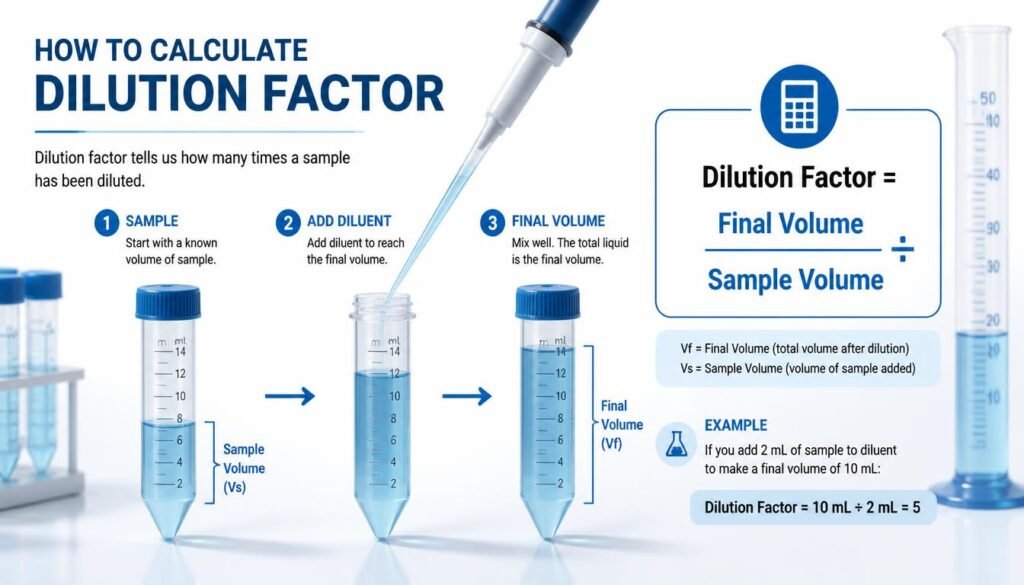
How to calculate dilution factor is easier than it may seem. In most cases, you divide the final total volume of a diluted solution by the volume of the original sample used to make it.
The basic formula is:
Dilution Factor (DF) = Final Volume ÷ Sample Volume
For example, if you take 10 mL of a sample and add enough diluent to make the final volume 100 mL, the dilution factor is:
DF = 100 mL ÷ 10 mL = 10
That means the sample was diluted 10-fold, often written as a 1:10 dilution.
This guide explains how to calculate dilution factor, use the dilution formula, work with concentration, solve serial dilution problems, and avoid common mistakes.
Table of Contents
What Is Dilution Factor?
The dilution factor tells you how much a solution has been diluted compared with its original concentration.
A dilution factor of 10 means the final solution is 10 times less concentrated than the starting solution.
The most common formula is:
DF = V₂ ÷ V₁
Where:
- DF = dilution factor
- V₁ = volume of the original sample used
- V₂ = final total volume after dilution
The final volume includes both the original sample and the diluent.
Example
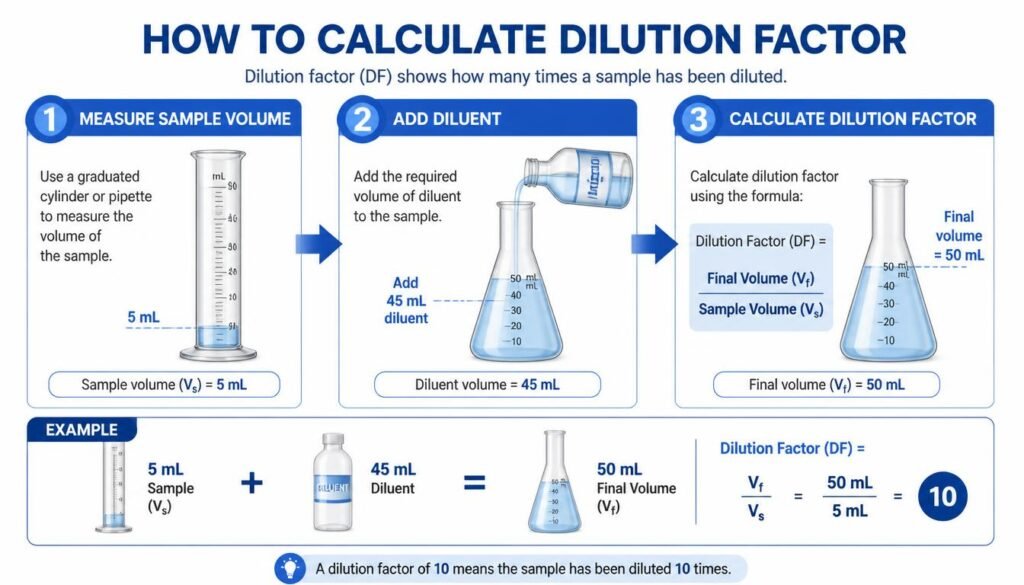
Suppose you mix:
- 5 mL of stock solution
- 45 mL of water
The final volume is 50 mL.
So:
DF = 50 mL ÷ 5 mL = 10
The solution has a 10-fold dilution.
Its concentration is therefore one-tenth of the original concentration.
How to Calculate Dilution Factor Step by Step
To calculate dilution factor, follow three simple steps.
Step 1: Find the volume of the original sample
Look for the amount of stock solution, concentrated sample, or original solution that was transferred.
Call this V₁.
For example:
V₁ = 2 mL
Step 2: Find the final total volume
Determine the total volume after adding the diluent.
Call this V₂.
For example, if 2 mL of sample is diluted to a final volume of 20 mL:
V₂ = 20 mL
Step 3: Divide final volume by sample volume
Use:
DF = V₂ ÷ V₁
So:
DF = 20 mL ÷ 2 mL = 10
The dilution factor is 10.
How to Calculate Dilution Factor From Concentrations
You can also calculate dilution factor when you know the original and final concentrations.
Use:
DF = C₁ ÷ C₂
Where:
- C₁ = original concentration
- C₂ = diluted concentration
Example
A solution starts at 80 mg/mL and is diluted to 20 mg/mL.
DF = 80 ÷ 20 = 4
So the solution was diluted by a factor of 4.
The final concentration is one-fourth of the original concentration.
Why the concentration formula works
Dilution does not change the amount of solute already present in the sample. Instead, it spreads that solute through a larger volume.
That is why concentration decreases as volume increases.
The relationship is commonly written as:
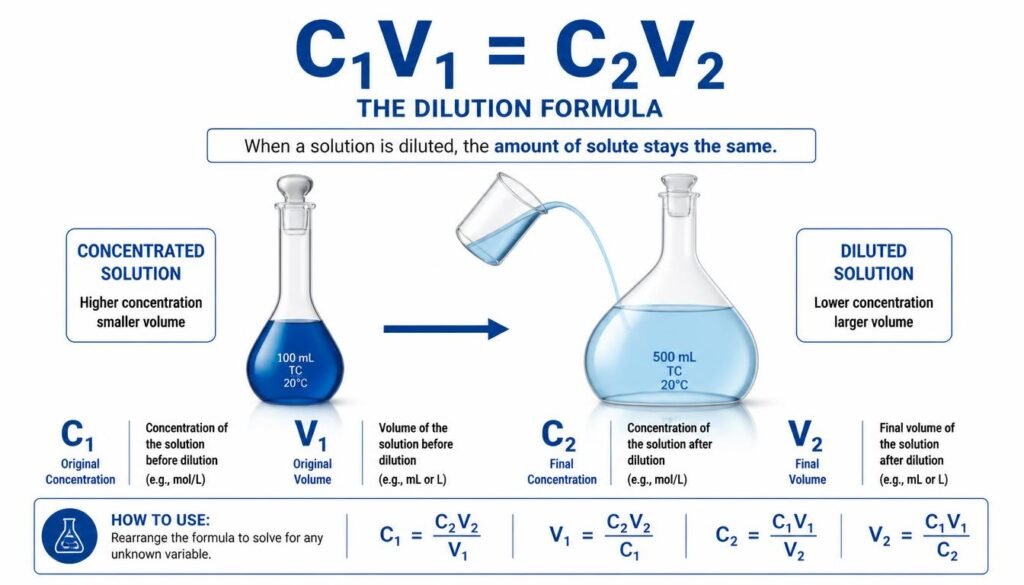
C₁V₁ = C₂V₂
This equation is useful when you need to calculate an unknown volume or concentration.
What Is the Dilution Formula C₁V₁ = C₂V₂?
The formula C₁V₁ = C₂V₂ is the standard equation used to solve many dilution problems.
Here:
- C₁ = starting concentration
- V₁ = volume of starting solution
- C₂ = final concentration
- V₂ = final volume
To find an unknown value, rearrange the equation.
For example:
V₁ = (C₂ × V₂) ÷ C₁
Example: Find the volume of stock solution needed
You have a 50 mg/mL stock solution and want to prepare 100 mL of a 5 mg/mL solution.
Using:
C₁V₁ = C₂V₂
Insert the values:
50 × V₁ = 5 × 100
50V₁ = 500
V₁ = 10 mL
So you need 10 mL of stock solution.
Then add enough diluent to reach a final volume of 100 mL.
The dilution factor is:
DF = 100 ÷ 10 = 10
So this is a 10-fold dilution.
Dilution Factor vs. Dilution Ratio
These terms are related, but they are not always written in the same way.
A 10-fold dilution means:
DF = 10
A 1:10 dilution generally means 1 part sample brought to 10 total parts.
For example:
- 1 mL sample + 9 mL diluent = 10 mL total
- Dilution factor = 10
- Final concentration = 1/10 of the starting concentration
This is different from saying 1 part sample + 10 parts diluent, which produces 11 total parts.
A useful rule
When a dilution is written as 1:X, check what the laboratory, protocol, or method means by that notation.
For calculations, the safest approach is to use the actual sample volume and final total volume.
How to Calculate Dilution Factor From Sample and Diluent Volumes
Sometimes a problem gives you the amount of sample and the amount of diluent instead of the final volume.
In that case:
Final Volume = Sample Volume + Diluent Volume
Then use:
DF = Final Volume ÷ Sample Volume
Example
You add:
- 4 mL sample
- 16 mL diluent
Final volume:
4 + 16 = 20 mL
Dilution factor:
20 ÷ 4 = 5
So the sample has been diluted 5-fold.
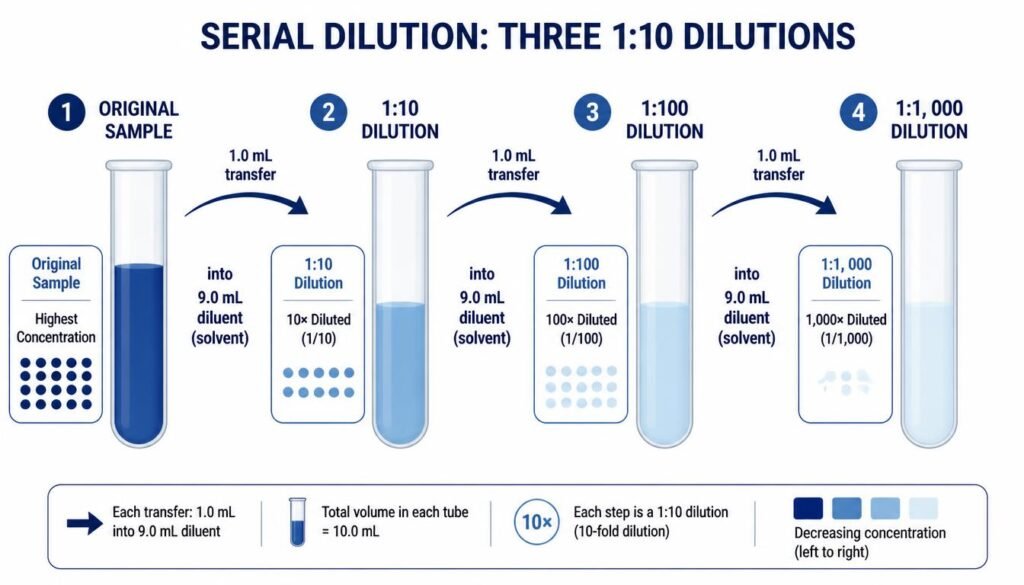
How to Calculate Dilution Factor in Serial Dilutions
A serial dilution involves making several dilutions in sequence.
The overall dilution factor is found by multiplying the dilution factor of each step.
Example
Suppose you make three 1:10 dilutions:
- Step 1: 1:10
- Step 2: 1:10
- Step 3: 1:10
The total dilution factor is:
10 × 10 × 10 = 1,000
So the final sample is a 1,000-fold dilution of the original.
The final concentration is:
Original concentration ÷ 1,000
Example with concentrations
Suppose the original solution is 100 mg/mL.
After three 10-fold dilutions:
100 ÷ 10 = 10 mg/mL
10 ÷ 10 = 1 mg/mL
1 ÷ 10 = 0.1 mg/mL
The final concentration is 0.1 mg/mL.
How to Calculate the Total Dilution Factor
For multiple dilution steps, use:
Total DF = DF₁ × DF₂ × DF₃ × …
Example
A sample goes through these dilutions:
- First dilution = 5-fold
- Second dilution = 10-fold
- Third dilution = 2-fold
Then:
Total DF = 5 × 10 × 2 = 100
The final sample is therefore 100-fold diluted relative to the original.
How to Calculate the Original Concentration After Dilution
Sometimes you know the concentration of a diluted sample and need to work backward to find the original concentration.
Use:
Original Concentration = Diluted Concentration × Dilution Factor
Example
A diluted sample has a concentration of 4 mg/mL, and the dilution factor is 25.
So:
Original concentration = 4 × 25 = 100 mg/mL
The original concentration was 100 mg/mL.
Common Dilution Factor Examples
| Sample Volume | Final Volume | Dilution Factor | Dilution |
|---|---|---|---|
| 1 mL | 10 mL | 10 | 1:10 |
| 2 mL | 20 mL | 10 | 1:10 |
| 5 mL | 50 mL | 10 | 1:10 |
| 10 mL | 100 mL | 10 | 1:10 |
| 5 mL | 25 mL | 5 | 1:5 |
| 1 mL | 100 mL | 100 | 1:100 |
The pattern is straightforward: the larger the final volume compared with the starting sample volume, the greater the dilution factor.
How to Calculate Dilution Factor in a Laboratory
In laboratory work, dilution factor calculations often appear when preparing standards, reagents, biological samples, chemical solutions, and analytical samples.
For accurate results:
- Record the exact sample volume.
- Determine the final total volume.
- Keep the units consistent.
- Divide final volume by sample volume.
- For serial dilutions, multiply the factors from each step.
For example, if 0.5 mL of sample is diluted to 5 mL:
DF = 5 ÷ 0.5 = 10
The sample has a 10-fold dilution.
Common Mistakes When Calculating Dilution Factor
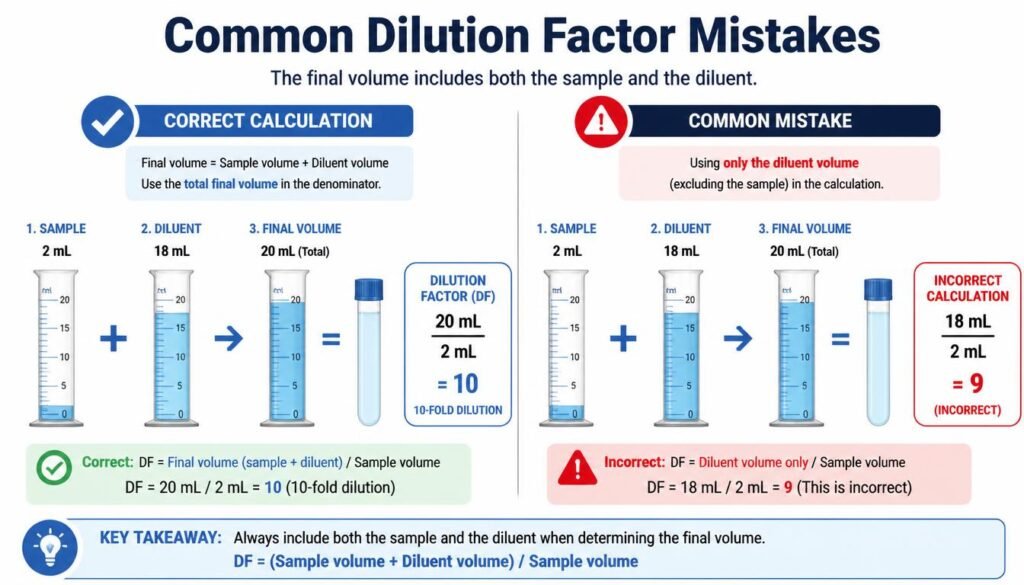
Using the volume of diluent instead of final volume
This is one of the most common errors.
Suppose you mix 2 mL of sample with 18 mL of diluent.
The diluent volume is 18 mL, but the final volume is 20 mL.
The correct calculation is:
DF = 20 ÷ 2 = 10
Not:
18 ÷ 2 = 9
Forgetting that final volume includes the sample
The final volume is the total volume after mixing, not just the amount of liquid added.
Reversing the formula
The standard dilution factor is:
Final volume ÷ sample volume
Not:
Sample volume ÷ final volume
The reversed calculation gives the fraction of the original concentration remaining, which is the reciprocal of the dilution factor.
For example:
2 ÷ 20 = 0.1
That value represents the remaining concentration fraction. The dilution factor is:
20 ÷ 2 = 10
Mixing up dilution factor and concentration
A dilution factor of 10 does not mean the concentration becomes 10 times higher.
It means the concentration becomes one-tenth of the original.
For example:
100 mg/mL ÷ 10 = 10 mg/mL
Multiplying the wrong values in serial dilution
For serial dilutions, multiply the individual dilution factors, not the final concentrations.
A 10-fold dilution followed by a 100-fold dilution gives:
10 × 100 = 1,000-fold
What Is the Difference Between Dilution Factor and Dilution Factor Reciprocal?
The dilution factor and the fraction of original concentration are reciprocals.
For example, with a 1:10 dilution:
Dilution factor = 10
Fraction remaining = 1/10 = 0.1
So if the original concentration is 60 units/mL:
60 × 0.1 = 6 units/mL
or:
60 ÷ 10 = 6 units/mL
Both approaches give the same result.
Quick Dilution Factor Cheat Sheet
The key formulas are:
Dilution factor:
DF = Final Volume ÷ Sample Volume
Concentration after dilution:
C₂ = C₁ ÷ DF
Original concentration:
C₁ = C₂ × DF
Standard dilution equation:
C₁V₁ = C₂V₂
Serial dilution:
Total DF = DF₁ × DF₂ × DF₃ × …
One simple example to remember
If you take 1 mL of sample and dilute it to 10 mL total:
DF = 10 ÷ 1 = 10
So:
- Dilution factor = 10
- Dilution = 1:10
- Final concentration = 1/10 of the original
FAQ: How to Calculate Dilution Factor
What is the formula for dilution factor?
The basic formula is DF = Final Volume ÷ Sample Volume. For example, 5 mL of sample diluted to 50 mL gives a dilution factor of 10.
How do you calculate a 1:10 dilution?
Use 1 part sample and enough diluent to make 10 total parts. For example, mix 1 mL sample with 9 mL diluent. The dilution factor is 10.
What is the dilution factor of 1 mL in 9 mL?
If you mix 1 mL of sample with 9 mL of diluent, the final volume is 10 mL. Therefore, the dilution factor is 10.
How do you calculate dilution factor from concentration?
Divide the original concentration by the diluted concentration:
DF = C₁ ÷ C₂
For example, 50 mg/mL diluted to 5 mg/mL gives a dilution factor of 10.
How do you calculate dilution factor in a serial dilution?
Multiply the dilution factors for every step. Three consecutive 1:10 dilutions give:
10 × 10 × 10 = 1,000
So the total dilution factor is 1,000.
Is a 1:10 dilution the same as a 10-fold dilution?
Yes, when the notation means 1 part original sample made up to 10 total parts. This is why it is useful to verify how a protocol defines dilution notation before performing the calculation.
How do you find the original concentration from a diluted sample?
Multiply the diluted concentration by the dilution factor.
For example:
5 mg/mL × 20 = 100 mg/mL
So the original concentration was 100 mg/mL.
Can dilution factor be less than 1?
The standard dilution factor for a true dilution is typically greater than or equal to 1. A value below 1 usually represents the fraction of the original concentration remaining rather than the dilution factor itself.
Conclusion
Knowing how to calculate dilution factor comes down to one core idea: compare the final total volume with the amount of original sample used.
Use:
DF = Final Volume ÷ Sample Volume
For concentration-based problems, use DF = C₁ ÷ C₂, and for standard dilution calculations, use C₁V₁ = C₂V₂. For serial dilutions, multiply the individual dilution factors together.
Once you identify the starting sample volume, final volume, and concentration when available, most dilution problems become simple substitution and arithmetic.