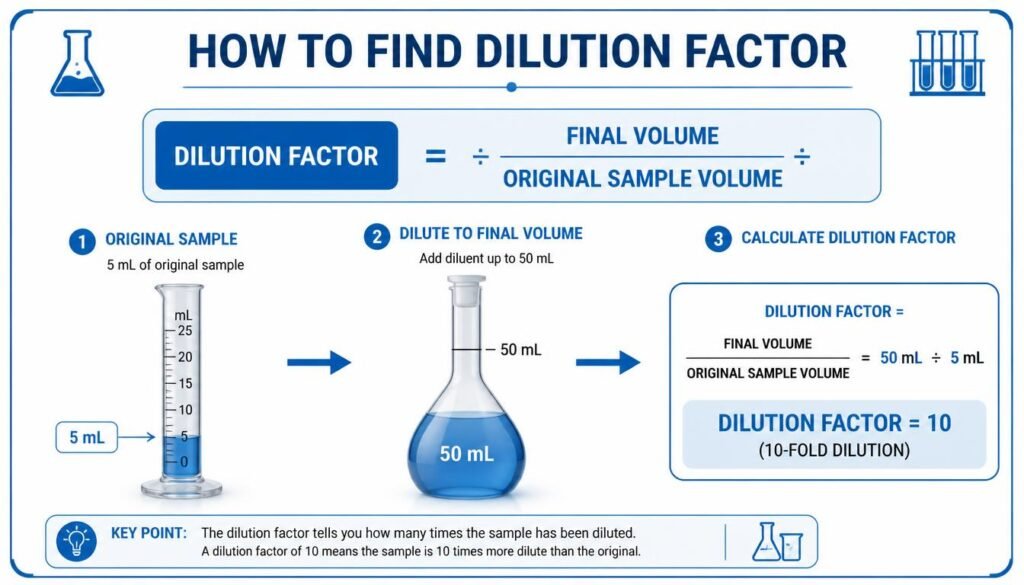
How to find dilution factor depends on the amount of original solution and the final volume after dilution. In most laboratory calculations, the dilution factor (DF) is found by dividing the final volume by the volume of the original sample used:
Dilution Factor = Final Volume ÷ Sample Volume
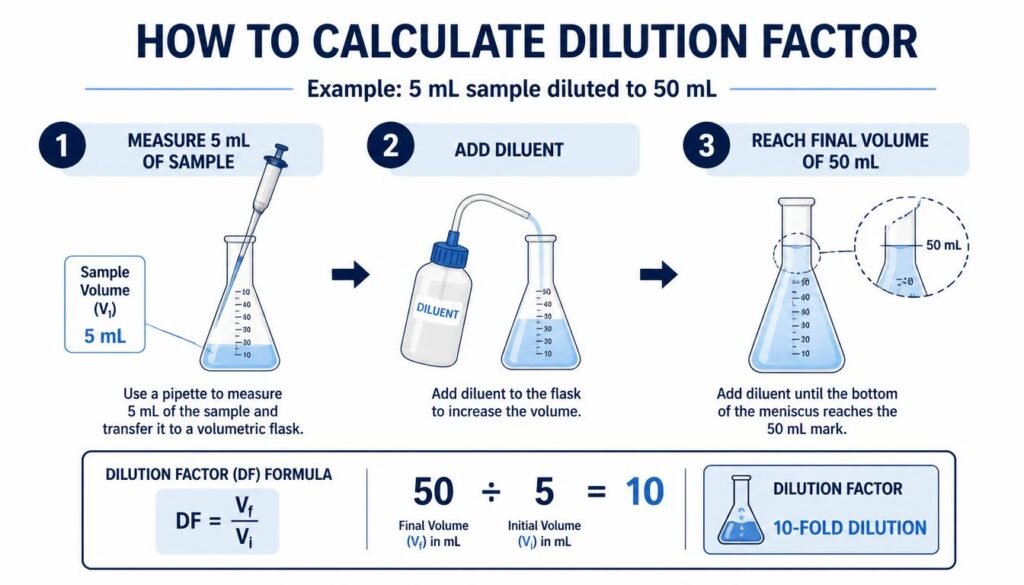
For example, if you take 5 mL of a sample and add enough solvent to make 50 mL total, the dilution factor is 50 ÷ 5 = 10. The sample has been diluted 10-fold.
This guide explains how to find dilution factor, how to use it in concentration calculations, how serial dilutions work, and how to avoid common mistakes.
Table of Contents
What Is a Dilution Factor?
A dilution factor tells you how many times a solution has been diluted compared with the original sample.
A 10-fold dilution means the final solution contains one part original sample in a total of 10 parts solution. A 100-fold dilution means the original sample has been diluted to one-hundredth of its original concentration.
The dilution factor itself does not have a unit because it is a ratio.
Dilution factor formula
The most common formula is:
DF = V₂ ÷ V₁
Where:
- DF = dilution factor
- V₁ = volume of the original sample used
- V₂ = final total volume after dilution
The final volume includes both the sample and the added diluent.
For example:
- Original sample = 2 mL
- Final volume = 20 mL
So:
DF = 20 mL ÷ 2 mL = 10
Therefore, the dilution factor is 10.
How to Find Dilution Factor Step by Step
To find dilution factor, follow these three steps.
Step 1: Find the volume of the original sample
Identify how much of the stock or original solution was transferred into the new container.
Call this V₁.
Step 2: Find the final total volume
Determine the total volume of the diluted solution after the diluent has been added.
Call this V₂.
Do not use only the volume of the solvent that was added. The formula uses the final total volume.
Step 3: Divide final volume by sample volume
Use:
Dilution Factor = Final Volume ÷ Original Sample Volume
Example
You pipette 4 mL of stock solution into a flask and add water until the total volume reaches 40 mL.
DF = 40 mL ÷ 4 mL = 10
The dilution factor is 10, or 1:10.
That means the final concentration is one-tenth of the original concentration.
How to Calculate Dilution Factor From a Dilution Ratio
Sometimes a dilution is written as a ratio instead of using volumes.
For example, a solution may be described as a 1:5 dilution.
This generally means:
1 part original sample + enough diluent to make 5 total parts
The dilution factor is therefore 5.
Likewise:
| Dilution | Dilution Factor |
|---|---|
| 1:2 | 2 |
| 1:5 | 5 |
| 1:10 | 10 |
| 1:20 | 20 |
| 1:100 | 100 |
| 1:1,000 | 1,000 |
One common source of confusion is the difference between the sample-to-diluent ratio and the sample-to-final-volume ratio. Always check how the ratio is being defined before doing the calculation.
How to Find Dilution Factor From Concentrations
You can also calculate dilution factor when you know the original and diluted concentrations.
Use:
DF = C₁ ÷ C₂
Where:
- C₁ = original concentration
- C₂ = final concentration
This relationship comes from the dilution equation:
C₁V₁ = C₂V₂
Example
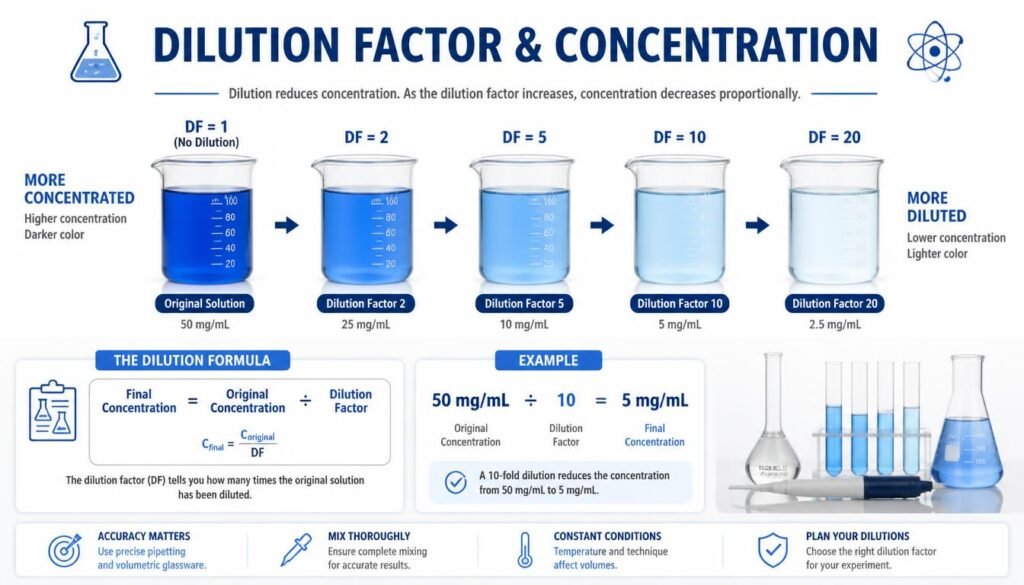
A stock solution has a concentration of 50 mg/mL. After dilution, the concentration is 5 mg/mL.
DF = 50 mg/mL ÷ 5 mg/mL = 10
So the sample was diluted 10-fold.
You can also see this from the volume equation:
C₁/C₂ = V₂/V₁
Both approaches should give the same dilution factor when the calculation is set up correctly.
How to Use Dilution Factor to Find a Final Concentration
Once you know the dilution factor, you can calculate the diluted concentration by dividing the original concentration by the dilution factor.
Final Concentration = Original Concentration ÷ Dilution Factor
Example
Suppose a stock solution is 80 mg/mL and the dilution factor is 20.
Final Concentration = 80 mg/mL ÷ 20 = 4 mg/mL
The diluted solution has a concentration of 4 mg/mL.
This is especially useful when a laboratory procedure tells you the dilution factor but asks you to determine the resulting concentration.
How to Find the Original Concentration From a Diluted Sample
The same relationship works in reverse.
Original Concentration = Final Concentration × Dilution Factor
Example
A diluted sample has a measured concentration of 3 mg/L, and it was diluted by a factor of 25.
Original Concentration = 3 mg/L × 25 = 75 mg/L
So the estimated concentration of the original sample is 75 mg/L.
This is common in analytical testing when a sample must be diluted before it can be measured accurately.
How to Find Dilution Factor in Serial Dilutions
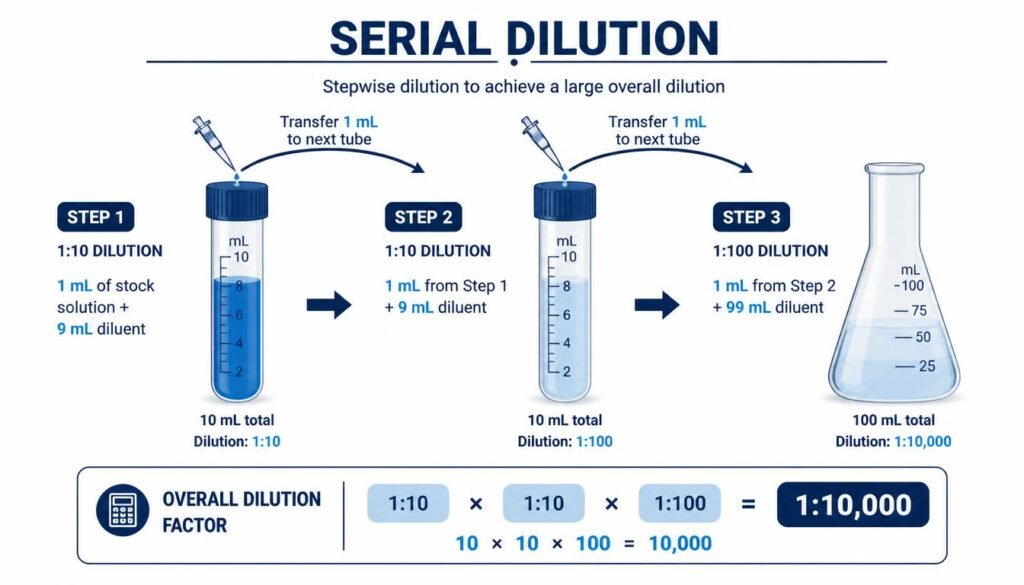
A serial dilution involves making several dilutions one after another. In this case, the overall dilution factor is found by multiplying the individual dilution factors.
Overall Dilution Factor = DF₁ × DF₂ × DF₃ × …
Example: Two-Step Serial Dilution
Suppose:
- The first dilution is 1:10
- The second dilution is 1:5
The total dilution factor is:
10 × 5 = 50
So the final sample is diluted 50-fold relative to the original solution.
Example: Three-Step Serial Dilution
Imagine three consecutive dilutions:
- 1:10
- 1:10
- 1:100
Multiply them:
10 × 10 × 100 = 10,000
The overall dilution factor is 10,000.
The final solution is therefore 10,000 times less concentrated than the starting sample.
How to Find Dilution Factor When You Add Solvent
A frequent mistake is using the volume of solvent added instead of the final volume.
Suppose you start with 10 mL of sample and add 90 mL of water.
The final volume is:
10 mL + 90 mL = 100 mL
So:
DF = 100 mL ÷ 10 mL = 10
The dilution factor is 10, not 9.
The added water is 90 mL, but the dilution calculation uses the total final volume of 100 mL.
How to Calculate the Volume Needed for a Specific Dilution
Sometimes the question is reversed: you know the dilution factor and final volume, and you need to determine how much original sample to use.
Rearrange the formula:
V₁ = V₂ ÷ DF
Example
You need to prepare 25 mL of a 5-fold dilution.
V₁ = 25 mL ÷ 5 = 5 mL
You need:
- 5 mL of the original sample
- Enough diluent to bring the total volume to 25 mL
That means you would add approximately 20 mL of diluent, assuming the stated volumes are appropriate for the preparation method.
Common Dilution Factor Examples
Here are several practical examples.
Example 1: 1 mL to 10 mL
You transfer 1 mL of stock solution and make the final volume 10 mL.
DF = 10 ÷ 1 = 10
Answer: 10-fold dilution
Example 2: 5 mL to 25 mL
You use 5 mL of sample and make the final volume 25 mL.
DF = 25 ÷ 5 = 5
Answer: 5-fold dilution
Example 3: 2 mL to 100 mL
You transfer 2 mL of sample and dilute it to a total volume of 100 mL.
DF = 100 ÷ 2 = 50
Answer: 50-fold dilution
Example 4: Concentration changes from 12 mg/mL to 0.12 mg/mL
Use the concentration formula:
DF = 12 ÷ 0.12 = 100
Answer: 100-fold dilution
Dilution Factor vs. Dilution Ratio
These terms are related, but they are not always written in exactly the same way.
A dilution factor tells you how much the original concentration has been reduced.
A dilution ratio describes the relative amounts of sample and final solution, or sometimes sample and diluent, depending on the convention being used.
For example, a 1:10 preparation may mean one part sample brought to 10 total parts. Under that convention, the dilution factor is 10.
Because notation can vary between laboratories, exam questions, and protocols, read the definition being used before assuming what a ratio means.
Common Mistakes When Finding Dilution Factor
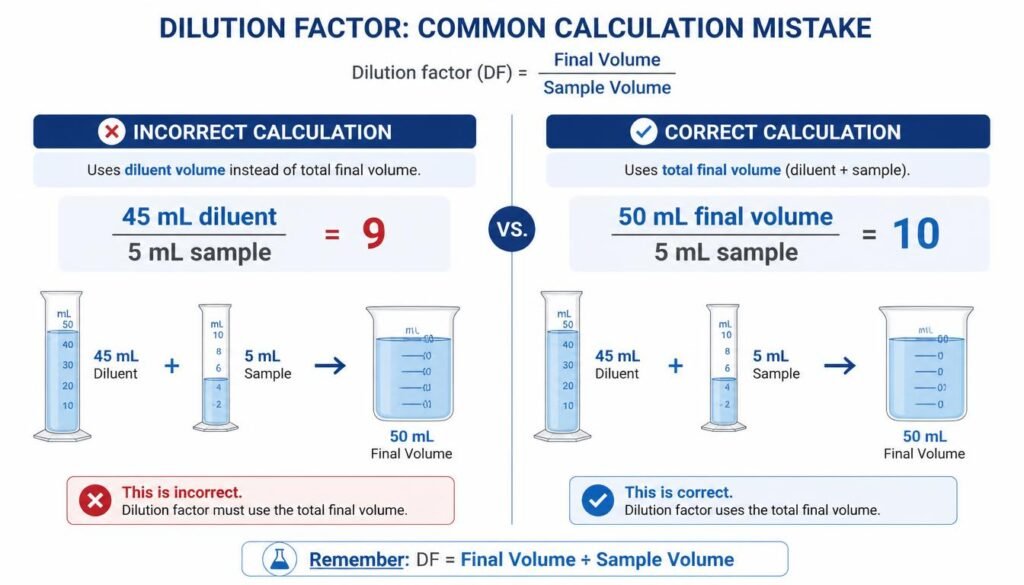
Using the amount of diluent instead of the final volume
This is probably the most common error.
For a 5 mL sample plus 45 mL diluent:
- Diluent volume = 45 mL
- Final volume = 50 mL
The correct calculation is:
50 ÷ 5 = 10
Not:
45 ÷ 5 = 9
Forgetting that concentrations go down as dilution factor goes up
A larger dilution factor means a lower final concentration.
For example:
- DF = 2 means the concentration becomes half as large.
- DF = 10 means the concentration becomes one-tenth as large.
- DF = 100 means the concentration becomes one-hundredth as large.
Mixing up the numerator and denominator
The standard volume formula is:
DF = Final Volume ÷ Original Sample Volume
Reversing the values gives the reciprocal, not the usual dilution factor.
Treating serial dilutions as separate from the total dilution
If a sample is diluted by 10 and then diluted by another 10, the total dilution factor is 100, not 20.
Multiply the individual factors:
10 × 10 = 100
Ignoring units or inconsistent measurements
The units in the numerator and denominator should be compatible.
For example:
20 mL ÷ 2 mL = 10
If one value is in milliliters and the other is in liters, convert them to compatible units before calculating.
A Quick Way to Check Your Answer
After calculating a dilution factor, ask whether the result makes sense.
If the final volume is larger than the original sample volume, the dilution factor should normally be greater than 1.
For example:
2 mL → 20 mL
gives:
DF = 10
You can also use the concentration as a check. If a 10-fold dilution starts at 50 mg/mL, the final concentration should be:
50 ÷ 10 = 5 mg/mL
If your answer is higher than the starting concentration, something is probably wrong.
What Is the Formula for Dilution Factor?
The standard formula is:
Dilution Factor = Final Volume ÷ Original Sample Volume
When concentrations are known, you can also use:
Dilution Factor = Original Concentration ÷ Final Concentration
For serial dilutions:
Overall Dilution Factor = Product of all individual dilution factors
These formulas are different ways of describing the same dilution relationship.
FAQ: How to Find Dilution Factor
What is the easiest way to find dilution factor?
Divide the final total volume by the volume of the original sample:
DF = Final Volume ÷ Sample Volume
For example, 5 mL diluted to 50 mL gives a dilution factor of 10.
Is a 1:10 dilution the same as a dilution factor of 10?
Usually, yes, when the ratio means 1 part original sample brought to 10 total parts. Always check the convention used in the instructions because ratio notation can sometimes be defined differently.
How do you calculate dilution factor from concentration?
Divide the original concentration by the final concentration:
DF = C₁ ÷ C₂
For example, 20 mg/mL diluted to 2 mg/mL gives a dilution factor of 10.
How do you calculate dilution factor for serial dilution?
Multiply all individual dilution factors together. Two successive 1:10 dilutions produce an overall dilution factor of 100.
Does dilution factor have units?
No. It is a ratio, so the units cancel when compatible units are used.
How do you find the final concentration from dilution factor?
Divide the original concentration by the dilution factor:
Final Concentration = Original Concentration ÷ Dilution Factor
How do you find how much sample to use for a dilution?
Use:
Sample Volume = Final Volume ÷ Dilution Factor
For example, to make 50 mL of a 10-fold dilution:
50 ÷ 10 = 5 mL
So you would start with 5 mL of the original sample and bring it to a total volume of 50 mL.
Why is dilution factor important in laboratory calculations?
Dilution factor lets you connect a diluted measurement back to the original sample. It is commonly used when a sample is too concentrated to measure directly or when a specific working concentration is needed.
Conclusion
Learning how to find dilution factor becomes straightforward once you identify the original sample volume and the final total volume. The key formula is:
Dilution Factor = Final Volume ÷ Original Sample Volume
You can also calculate it from concentration:
DF = Original Concentration ÷ Final Concentration
For serial dilutions, multiply the individual dilution factors to get the overall factor. The most important detail to remember is that the denominator is the amount of original sample, while the numerator is the total final volume, not simply the amount of diluent added.