Introduction
Many people search for how to convert milligrams into milliliters when working with medicines, liquids, chemicals, food products, or laboratory measurements.
The important thing to understand is simple: you cannot directly convert mg to mL without knowing more about the substance. A milligram measures mass, while a milliliter measures volume. The missing information is usually the substance’s density or its concentration.
For example, 500 mg of one liquid may take up a different volume than 500 mg of another liquid. That is why there is no universal conversion such as “1 mg = X mL.”
In this guide, you will learn exactly how to convert milligrams into milliliters, which formula to use, how to solve common examples, and what mistakes to avoid.
Table of Contents
What Are Milligrams and Milliliters?
Before learning how to convert milligrams into milliliters, it helps to understand what these two units actually measure.
What Is a Milligram?
A milligram (mg) is a unit of mass.
One milligram is one-thousandth of a gram:
1 mg = 0.001 g
The metric prefix milli- means one-thousandth, or 10⁻³.
Milligrams are often used to describe the amount of a substance by weight. You may see mg used for medicines, vitamins, food ingredients, and laboratory materials.
What Is a Milliliter?
A milliliter (mL) is a unit of volume.
One milliliter is one-thousandth of a liter:
1 mL = 0.001 L
NIST lists the milliliter as a commonly used submultiple of the liter.
Milliliters are commonly used to measure liquids, such as water, liquid medicine, oils, and solutions.
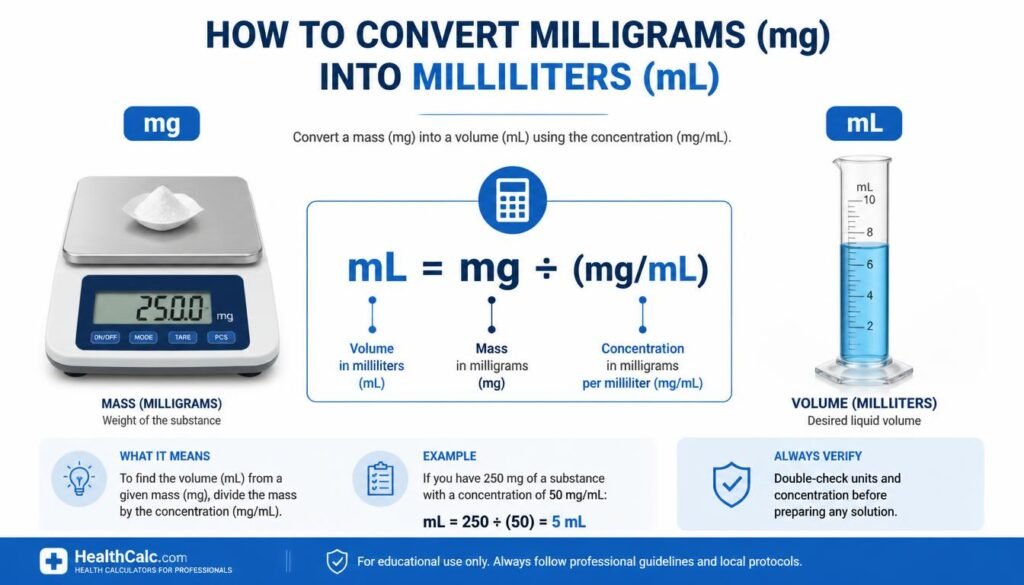
The Main Difference
The easiest way to remember the difference is:
- mg = mass
- mL = volume
This is why you cannot convert between them by simply moving a decimal point.
Can You Directly Convert Milligrams to Milliliters?
No, not by using a fixed conversion factor.
There is no universal rule that says:
1 mg = 1 mL
That would only be true under a very specific density relationship, and it is not true for every substance.
To convert mg to mL, you need information about what the substance is.
For a pure liquid, you may need its density.
For a prepared liquid, such as a medicine or solution, you may need its concentration, usually shown as something like:
This distinction is important because two liquids can have the same mass but different volumes.
How to Convert Milligrams Into Milliliters
The correct method depends on the information you have.
There are two common situations:
Method 1: Use Density
When you know the density of a substance, use:
Volume = Mass ÷ Density
If mass is given in milligrams, make sure the density uses compatible units.
For example, if density is given in mg/mL, the formula becomes:
mL = mg ÷ (mg/mL)
The mg units cancel, leaving mL.
Method 2: Use Concentration
When you know the concentration of a solution, use:
Volume (mL) = Amount (mg) ÷ Concentration (mg/mL)
This is often the easiest method for prepared liquid products.
For example, if a liquid contains:
and you need:
250 mg
then:
250 mg ÷ 100 mg/mL = 2.5 mL
So, 250 mg is contained in 2.5 mL of that particular solution.
Formula for Converting mg to mL
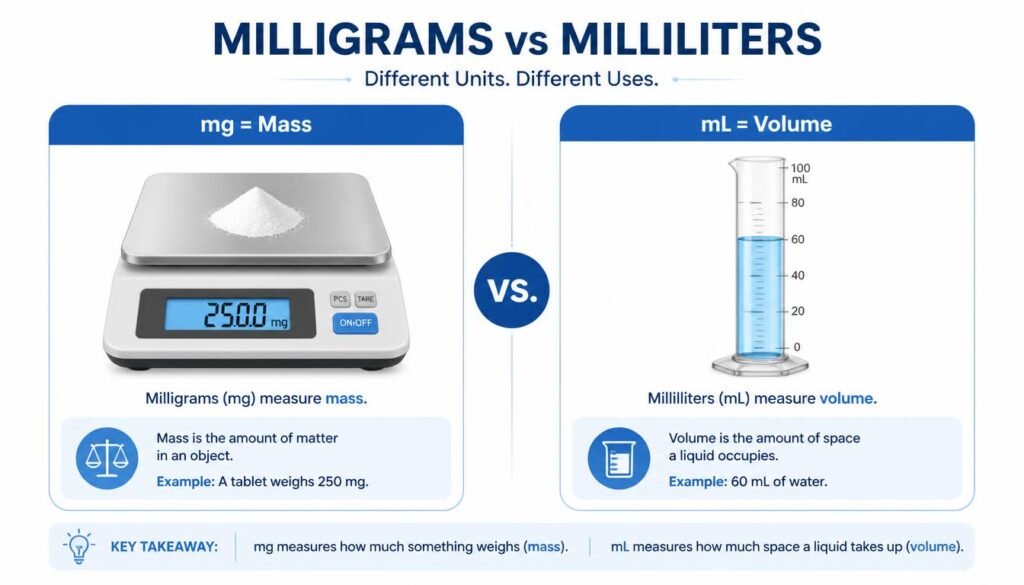
The most useful formula for many liquid solutions is:
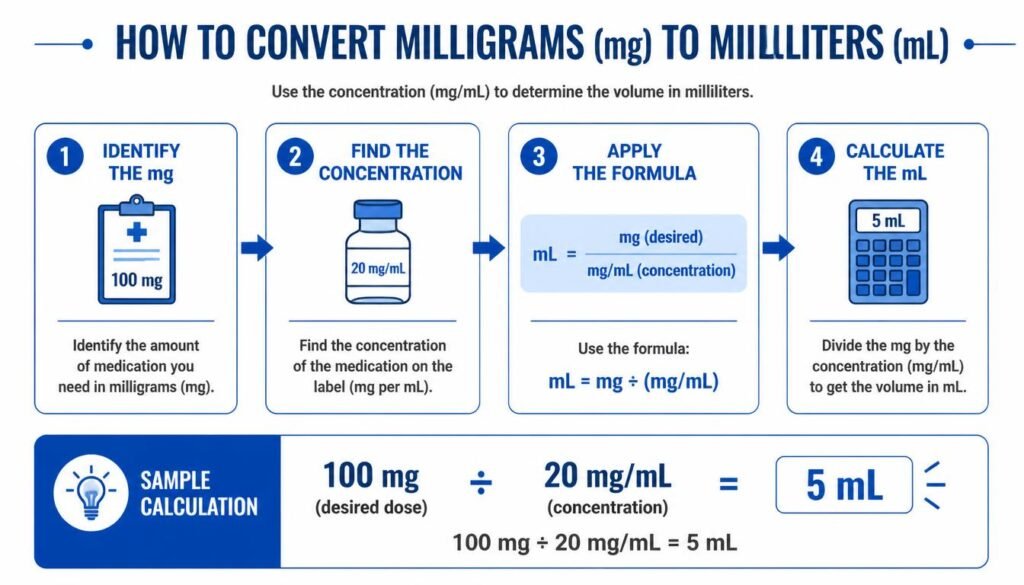
mL = mg ÷ (mg/mL)
Where:
- mg = amount of the substance
- mg/mL = concentration
- mL = volume
Example
Suppose a liquid has a concentration of 20 mg/mL.
You want to find the volume that contains 80 mg.
Use the formula:
mL = 80 ÷ 20
mL = 4
So, 80 mg = 4 mL of that specific solution.
Notice that this does not mean 80 mg always equals 4 mL. It only applies to a solution with a concentration of 20 mg/mL.
How to Convert mg to mL Using Density
Density tells you how much mass is packed into a certain volume.
The general formula is:
Density = Mass ÷ Volume
To find volume:
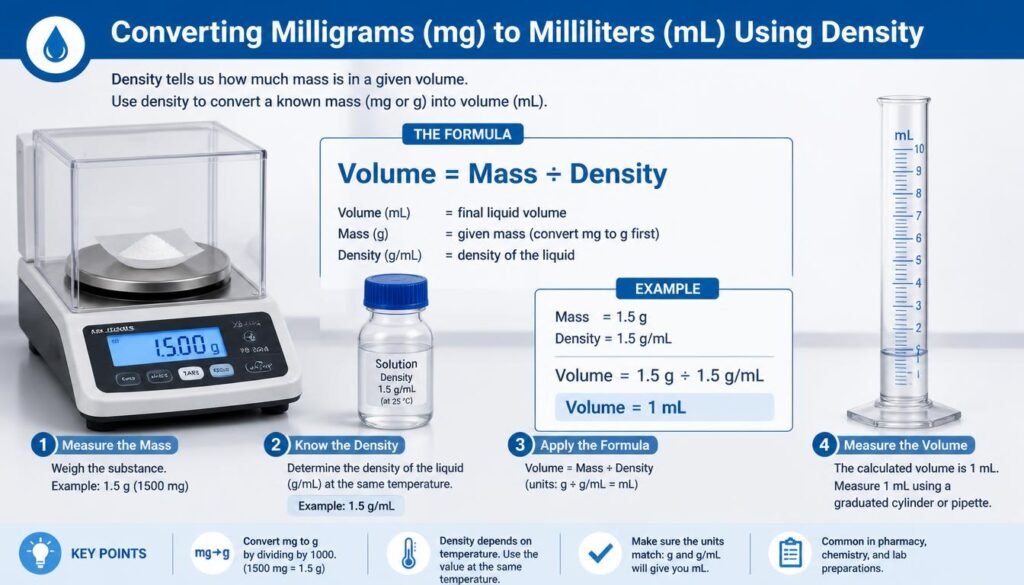
Volume = Mass ÷ Density
Example
Imagine a liquid has a density of:
0.8 g/mL
You have:
4 g
The calculation is:
Volume = 4 g ÷ 0.8 g/mL
Volume = 5 mL
So, 4 grams of that liquid occupies 5 mL.
What If the Mass Is Given in Milligrams?
First, convert milligrams to grams.
For example:
4,000 mg = 4 g
Then use the density formula.
This step is important because the mass and density units must match.
Another Example
Suppose you have:
1,500 mg
and the substance has a density of:
1.5 g/mL
First convert the mass:
1,500 mg = 1.5 g
Now calculate:
Volume = 1.5 g ÷ 1.5 g/mL
Volume = 1 mL
Therefore:
1,500 mg = 1 mL for a substance with a density of 1.5 g/mL.
Again, this result depends entirely on the density.
How to Convert mg to mL Using Concentration
For many liquid mixtures, you do not need density. Instead, the label gives the amount of substance per milliliter.
For example:
25 mg/mL
This means every 1 mL contains 25 mg of the substance.
To find the volume for a particular amount:
Volume = Desired amount ÷ Concentration
Example 1: 50 mg at 25 mg/mL
50 ÷ 25 = 2 mL
Answer:
2 mL
Example 2: 75 mg at 25 mg/mL
75 ÷ 25 = 3 mL
Answer:
3 mL
Example 3: 120 mg at 40 mg/mL
120 ÷ 40 = 3 mL
Answer:
3 mL
This method is especially useful when a product label clearly provides a concentration in mg/mL.
Step-by-Step: How to Convert Milligrams Into Milliliters
Here is a simple process beginners can follow.
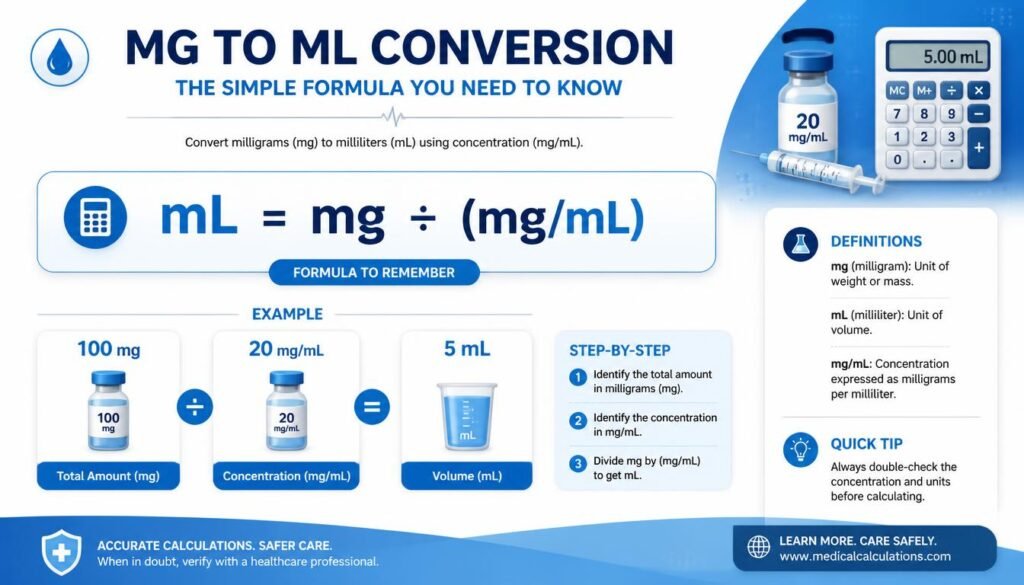
Step 1: Identify the Amount in Milligrams
Start with the amount you want to convert.
Example:
200 mg
Step 2: Find the Density or Concentration
Look at the product label, technical information, or trusted reference.
Suppose the concentration is:
50 mg/mL
Step 3: Use the Formula
mL = mg ÷ (mg/mL)
Step 4: Insert the Numbers
mL = 200 ÷ 50
Step 5: Calculate
mL = 4
Final Answer
200 mg = 4 mL for a solution containing 50 mg per mL.
This five-step method works well for many mg-to-mL questions involving solutions.
Practical Examples of mg to mL Conversion
Let’s look at several examples.
Example 1: 10 mg to mL
Suppose the concentration is:
5 mg/mL
Calculation:
10 ÷ 5 = 2 mL
Answer:
10 mg = 2 mL
Example 2: 30 mg to mL
Suppose the concentration is:
10 mg/mL
Calculation:
30 ÷ 10 = 3 mL
Answer:
30 mg = 3 mL
Example 3: 100 mg to mL
Suppose the concentration is:
20 mg/mL
Calculation:
100 ÷ 20 = 5 mL
Answer:
100 mg = 5 mL
Example 4: 250 mg to mL
Suppose the concentration is:
50 mg/mL
Calculation:
250 ÷ 50 = 5 mL
Answer:
250 mg = 5 mL
Example 5: 500 mg to mL
Suppose the concentration is:
100 mg/mL
Calculation:
500 ÷ 100 = 5 mL
Answer:
500 mg = 5 mL
These examples show why knowing the concentration is essential.
Common mg to mL Conversions
There is no universal mg-to-mL table because the answer changes with the substance.
However, when a liquid has a known concentration, the calculation becomes easy.
| Amount | Concentration | Volume |
|---|---|---|
| 10 mg | 10 mg/mL | 1 mL |
| 20 mg | 10 mg/mL | 2 mL |
| 50 mg | 10 mg/mL | 5 mL |
| 100 mg | 20 mg/mL | 5 mL |
| 200 mg | 50 mg/mL | 4 mL |
| 500 mg | 100 mg/mL | 5 mL |
These are examples, not universal conversions.
For instance, 100 mg could equal 1 mL, 2 mL, 5 mL, or another volume depending on the concentration or density.
How to Convert mg to mL for Liquid Medicines
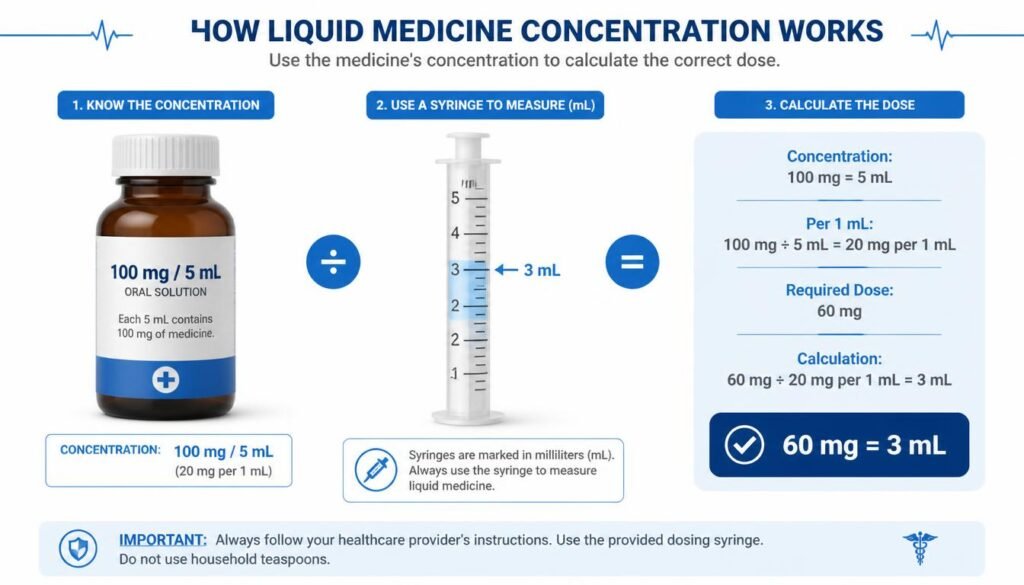
Liquid medicine labels often provide a concentration such as:
This means the full 5 mL contains 100 mg.
You can first find the amount per 1 mL:
100 mg ÷ 5 mL = 20 mg/mL
Then use the mg-to-mL formula.
Example
Suppose the label says:
100 mg per 5 mL
You need to determine the volume containing 60 mg.
First find the concentration:
100 ÷ 5 = 20 mg/mL
Now calculate:
60 ÷ 20 = 3 mL
So, the calculated volume is:
3 mL
Important Safety Note
When converting a medicine dose, use the concentration exactly as shown on the product label or provided by a qualified healthcare professional.
Do not assume that two products with the same medicine name have the same concentration. Different products can have different strengths.
For medication use, the calculation should be checked against the official label and, when needed, a pharmacist or other qualified healthcare professional.
What Does mg/mL Mean?
The unit mg/mL means milligrams per milliliter.
It tells you how much substance is present in one milliliter of a solution.
For example:
30 mg/mL
means:
30 mg of substance in every 1 mL of solution.
This makes mg/mL one of the most useful units for solving liquid dose and concentration problems.
Once you know the mg/mL value, the basic conversion is:
mL = mg ÷ mg/mL
Benefits of Knowing the Correct mg to mL Conversion
Understanding how to convert milligrams into milliliters can help you in many situations.
Easier Measurements
You can understand how much liquid corresponds to a known amount of a substance.
Fewer Calculation Errors
Using the correct formula reduces the chance of mixing up mass and volume units.
Better Label Reading
You can understand labels that show values such as:
- mg/mL
- mg/5 mL
- g/L
- mg per serving
Useful for Everyday Tasks
The same idea can help with:
- Liquid products
- Food ingredients
- Laboratory solutions
- Chemical mixtures
- Educational science problems
The main benefit is knowing what information is needed before doing the calculation.
Common Mistakes When Converting Milligrams to Milliliters
Many errors happen because people treat mg and mL as if they were the same kind of unit.
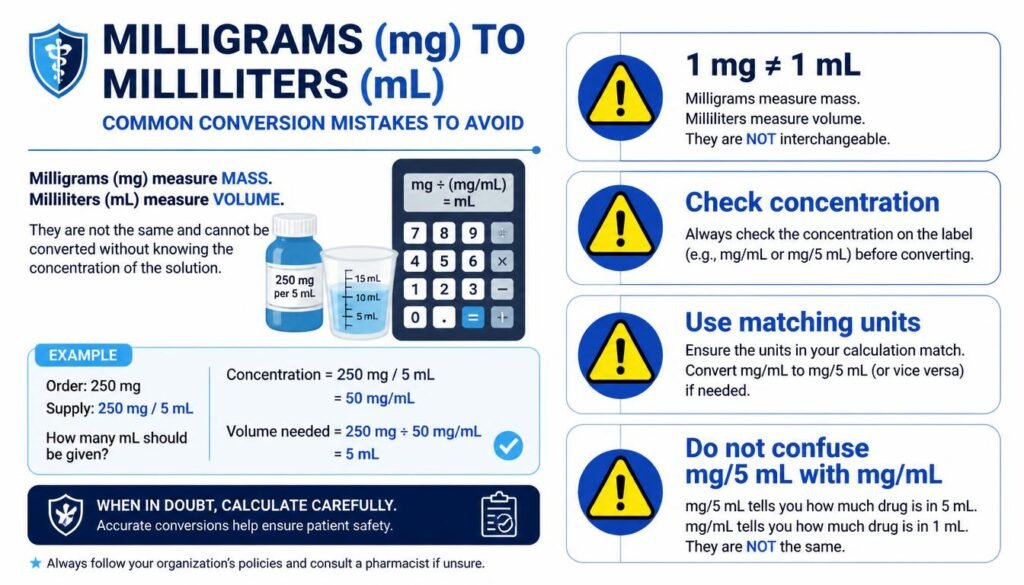
Mistake 1: Assuming 1 mg = 1 mL
This is not generally true.
Mass and volume are different measurements.
Mistake 2: Ignoring Concentration
If you are converting a solution, the concentration is often the most important piece of information.
Without it, you may not be able to calculate the answer.
Mistake 3: Mixing Units
For example, using grams with a density written in mg/mL can produce a wrong result.
Always make the units compatible.
Mistake 4: Reading mg/5 mL as mg/mL
These are not the same.
For example:
means the full 5 mL contains 50 mg.
The concentration is:
10 mg/mL
Mistake 5: Rounding Too Early
Keep enough decimal places during the calculation and round only at the end when appropriate.
Mistake 6: Using the Wrong Product Strength
Two products may contain the same ingredient but have different concentrations.
Always check the exact label.
Tips for Accurate mg to mL Calculations
Here are some practical tips that make the process easier.
Check the Units First
Ask:
- Is the amount in mg or g?
- Is the volume in mL or L?
- Is the concentration written as mg/mL or mg/5 mL?
- Is the density given in g/mL?
Write the Formula Before Entering Numbers
This simple habit helps prevent mistakes.
For a solution:
Convert Units Before Calculating
If your mass is in grams and your concentration is in mg/mL, convert one of them so they match.
For example:
1 g = 1,000 mg
Check Whether the Answer Makes Sense
If you are dividing by a larger concentration, the resulting volume may be less than 1 mL.
If you divide by a smaller concentration, the volume may be larger.
A quick sense check can catch simple errors.
When You Cannot Convert mg to mL
Sometimes the information provided is not enough.
For example, someone may ask:
That question alone does not contain enough information.
You would need something such as:
200 mg of what?
And, depending on the situation:
What is its density or concentration?
Without that information, there is no single correct answer.
This is one of the most important things to remember about how to convert milligrams into milliliters.
mg to mL Conversion vs. mL to mg
These two calculations are related but not identical.
mg to mL
When converting an amount into a volume:
mL = mg ÷ concentration
mL to mg
When converting a volume into an amount:
mg = mL × concentration
Example
A solution contains:
25 mg/mL
For 4 mL:
4 × 25 = 100 mg
So:
4 mL = 100 mg
And going backward:
100 ÷ 25 = 4 mL
Both formulas should give matching answers when used correctly.
How a Calculator Can Help
An online mg to mL calculator can make these calculations faster, especially when you work with decimal values.
However, a calculator still needs the correct inputs.
A typical converter may ask for:
- Amount in mg
- Concentration in mg/mL
For example:
Amount = 150 mg
Concentration = 30 mg/mL
Then:
150 ÷ 30 = 5 mL
A calculator reduces the amount of manual arithmetic, but it cannot determine the correct concentration for you.
Always enter the values exactly as provided by the source you are using.
Frequently Asked Questions
What Is the Formula for How to Convert Milligrams Into Milliliters?
For a solution with a known concentration:
mL = mg ÷ (mg/mL)
For a substance with a known density:
Volume = Mass ÷ Density
The correct formula depends on the information available.
How Does Converting mg to mL Work?
The conversion works by connecting mass and volume through either concentration or density.
For a solution, divide the amount in mg by the concentration in mg/mL.
For example:
100 mg ÷ 20 mg/mL = 5 mL
How Many mL Is 1 mg?
There is no universal answer.
The volume depends on the substance’s density or concentration.
For a solution with 10 mg/mL:
1 mg ÷ 10 mg/mL = 0.1 mL
But another solution could produce a different answer.
How Many mL Is 100 mg?
It depends on the concentration or density.
For a liquid with a concentration of 20 mg/mL:
100 mg = 5 mL
For a different concentration, the answer will change.
How Many mL Is 500 mg?
You need the substance’s concentration or density.
For example, at 100 mg/mL:
500 ÷ 100 = 5 mL
So, 500 mg would equal 5 mL for that particular solution.
Can I Convert mg to mL Without Density?
Sometimes, yes.
If you have a solution’s concentration in mg/mL, you do not need to know density for the basic calculation.
Use:
mL = mg ÷ mg/mL
However, if you do not know concentration or density, you generally cannot determine the volume from mass alone.
Is mg/mL the Same as mg/5 mL?
No.
For example:
50 mg/5 mL
means 50 mg is found in 5 mL.
To convert it to mg/mL:
50 ÷ 5 = 10 mg/mL
So:
50 mg/5 mL = 10 mg/mL
What Is the Difference Between mg and mL?
A milligram measures mass.
A milliliter measures volume.
You need another relationship, such as density or concentration, to connect the two.
Can Water Be Used as a Simple Example?
Yes, but you should still pay attention to the units.
For water near room temperature, 1 mL has a mass close to 1 gram, but the exact density depends on temperature. For precise scientific work, use the appropriate density value rather than assuming an exact 1 g/mL relationship.
Is There a Universal mg to mL Chart?
No.
There is no universal chart that works for every substance because mass-to-volume relationships depend on density or solution concentration.
A chart is only useful when it is tied to a specific substance or concentration.
Why Are mg and mL Often Used Together?
They are commonly used together when describing liquid solutions.
For example:
tells you both the amount of a substance and the volume used to express its concentration.
This makes it easy to calculate how much substance is present in a certain volume.
Quick Reference Formula
For a solution:
mL = mg ÷ (mg/mL)
For a known density:
Volume = Mass ÷ Density
For the reverse conversion:
mg = mL × (mg/mL)
These three formulas cover many common beginner calculations.
Final Takeaway: How to Convert Milligrams Into Milliliters
Learning how to convert milligrams into milliliters becomes much easier once you understand one basic rule: mg measures mass, while mL measures volume.
Because they measure different things, there is no single mg-to-mL conversion that works for every substance.
For a liquid solution with a known concentration, use:
mL = mg ÷ (mg/mL)
For a substance with a known density, use:
Volume = Mass ÷ Density
Always check the units, use the correct concentration or density, and avoid assuming that 1 mg equals 1 mL.
When dealing with medicines, chemical solutions, or any situation where an incorrect amount could matter, verify the concentration on the official label and seek professional guidance when necessary.
Once you know the concentration or density, the calculation itself is usually simple: identify the values, use the correct formula, calculate, and check the units.