
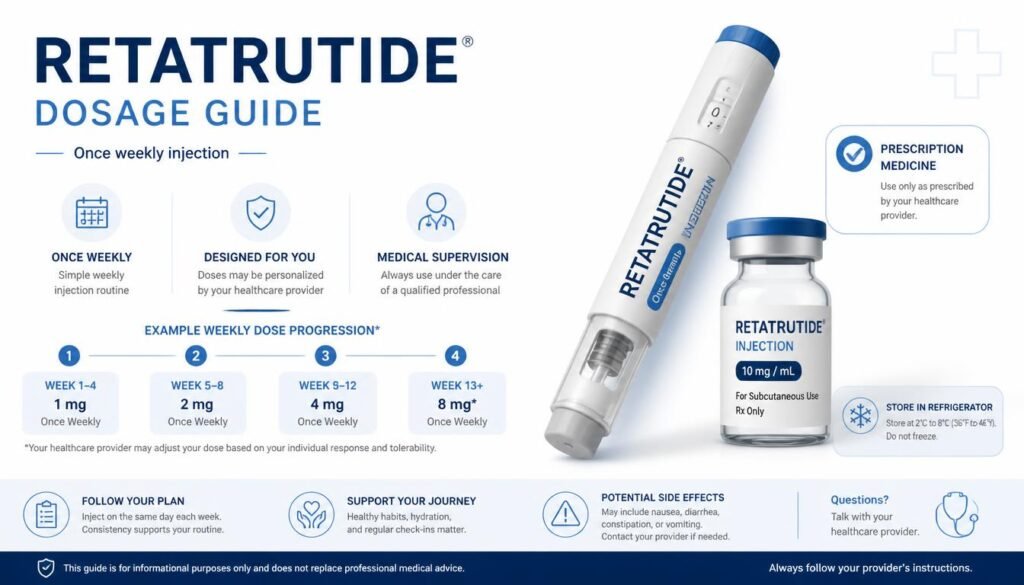
What is the retatrutide doseage? Retatrutide, more correctly spelled retatrutide dosage, does not currently have an FDA-approved dosing schedule for routine patient use because the drug remains investigational. In clinical trials, retatrutide has been studied as a once-weekly injection, with participants starting at a low dose and gradually increasing to a target dose such as 4 mg, 9 mg, or 12 mg.
This guide explains the retatrutide doses researchers have studied, how dose escalation works in clinical trials, why there is no standard personal dosage yet, and what people should know before considering products sold online.
Table of Contents
What Is the Retatrutide Doseage?
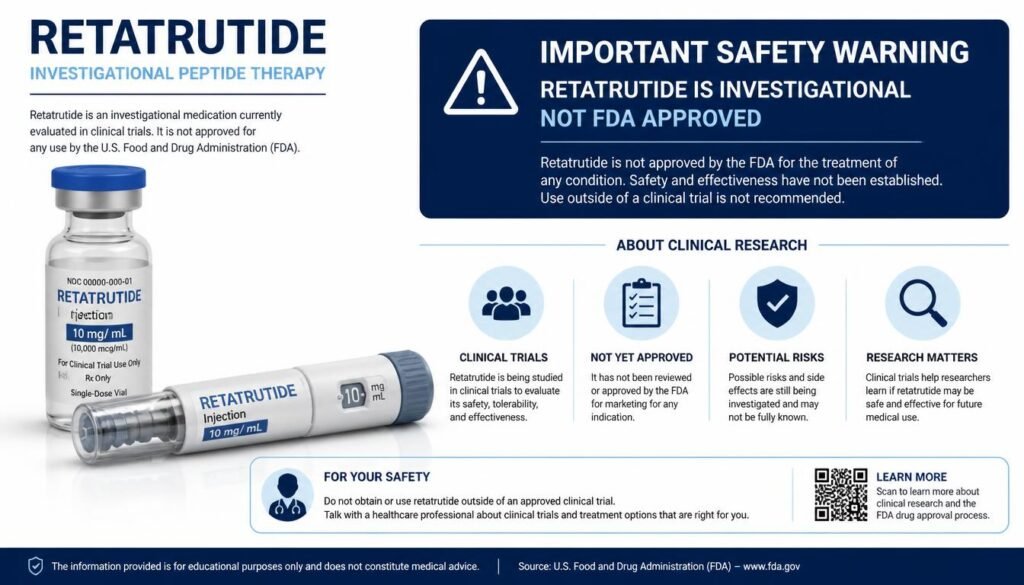
There is no single approved retatrutide dosage for the general public at this time. Retatrutide is still an investigational medicine, and Lilly states that it has not been approved by any regulatory agency and should not be taken outside a Lilly-sponsored clinical trial.
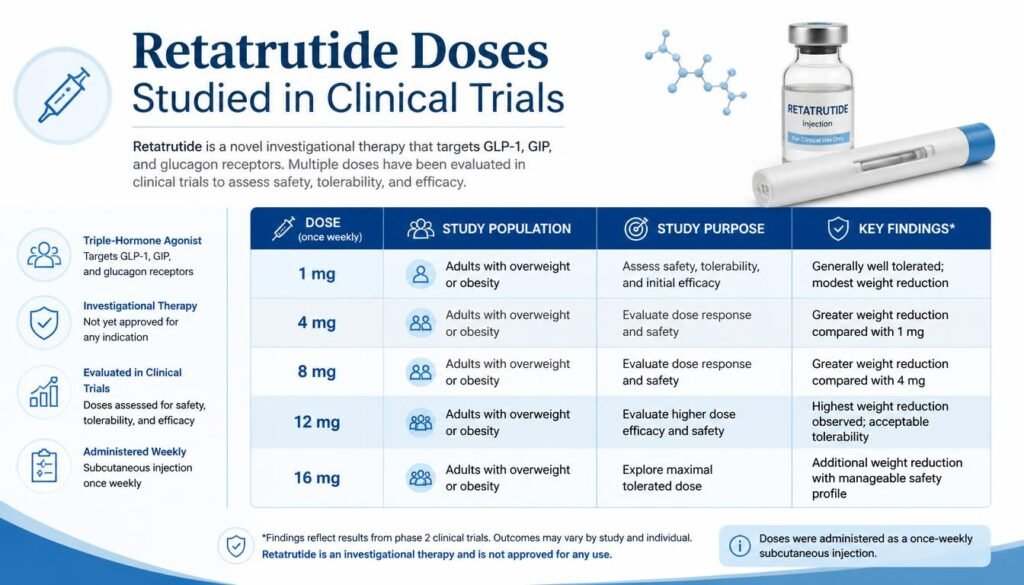
Researchers have nevertheless studied several retatrutide doses in clinical trials. Earlier Phase 2 research evaluated 1 mg, 4 mg, 8 mg, and 12 mg once weekly, while later Phase 3 studies have focused on target doses including 4 mg, 9 mg, and 12 mg.
That distinction matters: a dose used in a clinical trial is not the same thing as an approved prescription dosage.
What Retatrutide Doses Have Been Studied?
Clinical research has tested different dose levels to understand how retatrutide affects body weight, blood sugar, side effects, and other outcomes.
| Clinical research | Doses studied or targeted | How given |
|---|---|---|
| Phase 2 obesity trial | 1 mg, 4 mg, 8 mg, 12 mg | Once weekly |
| TRIUMPH Phase 3 program | 2 mg, 4 mg, 6 mg, 9 mg, 12 mg during escalation/targeting | Once weekly |
| TRIUMPH-1 | 4 mg, 9 mg, 12 mg target doses | Started at 2 mg and increased gradually |
| TRIUMPH-2 | 4 mg, 9 mg, 12 mg target doses | Started at 2 mg and increased gradually |
| TRIUMPH-3 and TRIUMPH-4 | 9 mg and 12 mg target doses | Started at 2 mg and increased gradually |
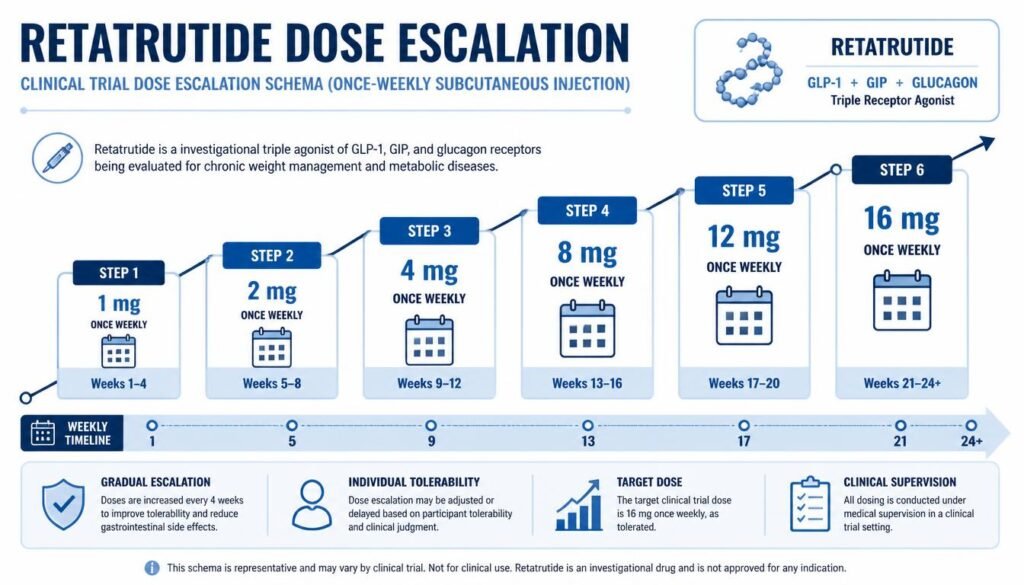
The Phase 3 program used a stepwise approach, with doses increased every four weeks until the assigned target was reached.
What Was the Retatrutide Starting Dose in Clinical Trials?
In the later TRIUMPH Phase 3 trials, participants generally started with 2 mg once weekly. The dose was then increased step by step rather than jumping immediately to a higher target dose.
For example, a Phase 3 study could use an escalation path like:
2 mg → 4 mg → 6 mg → 9 mg → 12 mg
The exact stopping point depended on the trial and its assigned target dose. For example, a participant assigned to a 9 mg target did not necessarily continue to 12 mg.
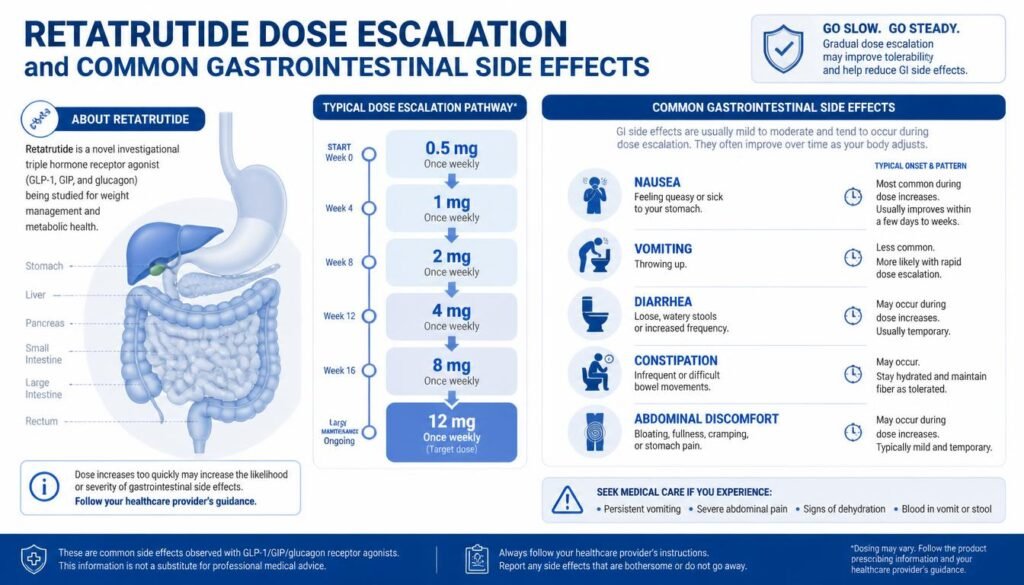
Researchers use gradual escalation partly because gastrointestinal side effects can become more noticeable as the dose increases.
Why Does Retatrutide Use Dose Escalation?
Dose escalation means starting with a lower amount and increasing it gradually over time.
This approach was important in retatrutide research because gastrointestinal side effects were among the most common adverse events and showed a relationship with dose. In the Phase 2 trial, researchers also found that using a lower starting dose helped reduce these problems compared with beginning at a higher dose.
Common gastrointestinal side effects reported during the Phase 2 study included symptoms such as nausea and other digestive problems. The study also observed dose-dependent increases in heart rate, which later declined.
Because of these safety considerations, increasing a dose faster than the clinical-study protocol is not something people should attempt on their own.
Is 12 mg the Recommended Retatrutide Dose?
No. 12 mg should not be described as an approved or universally recommended retatrutide dose.
A 12 mg target has been studied extensively, including in Phase 2 and Phase 3 research, but that does not mean everyone should take 12 mg. Clinical trials assign doses under controlled conditions, with screening, medical monitoring, predefined escalation schedules, and safety assessments.
In fact, Phase 3 research has included several different target doses, including 4 mg, 9 mg, and 12 mg. This shows why simply choosing the highest studied dose is not an appropriate way to determine an individual treatment plan.
How Is Retatrutide Given?
In clinical trials, retatrutide has been administered as a subcutaneous injection once per week.
“Subcutaneous” means the medicine is injected into the fatty tissue beneath the skin rather than directly into a vein. The Phase 2 trial and later TRIUMPH studies used weekly administration.
The actual injection method, product formulation, device, storage requirements, and administration instructions for any future approved version would depend on the final regulatory product labeling.
Retatrutide Dosage vs. Retatrutide Doseage: Is There a Difference?
The terms describe the same idea, but “dosage” is the standard spelling.
People searching online may type phrases such as:
- what is the retatrutide doseage
- retatrutide doseage
- retatrutide dosage
- retatrutide dosage for weight loss
- retatrutide starting dose
- retatrutide dose escalation
The medically accurate spelling is dosage, but the phrase “what is the retatrutide doseage” is still useful to recognize because it reflects how some people search for this information.
What Is the Retatrutide Dosage for Weight Loss?
There is currently no FDA-approved retatrutide dosage for weight loss.
Retatrutide is being developed for obesity and related conditions, and clinical trials have studied multiple doses. In the Phase 2 obesity trial, participants received 1 mg, 4 mg, 8 mg, or 12 mg once weekly.
Later Phase 3 research used target doses of 4 mg, 9 mg, and 12 mg, with participants starting at 2 mg and gradually increasing the dose every four weeks.
These study doses provide information about how researchers are evaluating retatrutide, but they should not be treated as instructions for self-medication.
What Did Clinical Trials Show About Different Doses?
The Phase 2 obesity trial found greater average weight reduction at higher studied doses over the 48-week treatment period.
At 48 weeks, the reported least-squares mean change in body weight was approximately:
- 1 mg: −8.7%
- 4 mg: −17.1%
- 8 mg: −22.8%
- 12 mg: −24.2%
- Placebo: −2.1%
These are clinical-trial results and should not be interpreted as a guarantee of how much weight an individual will lose.
The same study found that gastrointestinal adverse events were common and tended to increase with dose, which is one reason researchers evaluated gradual dose escalation.
What Are the Current Phase 3 Retatrutide Doses?
The Phase 3 TRIUMPH program has used a broader dose-escalation plan.
Participants started at 2 mg once weekly and increased the dose every four weeks. Depending on the assigned target, the escalation could include 2 mg, 4 mg, 6 mg, 9 mg, and 12 mg.
For example:
4 mg target
The participant started at 2 mg and then increased to 4 mg.
9 mg target
The participant started at 2 mg and progressed through 4 mg and 6 mg before reaching 9 mg.
12 mg target
The participant started at 2 mg and progressed through 4 mg, 6 mg, and 9 mg before reaching 12 mg.
These schedules describe clinical-trial protocols, not a prescription for someone outside a study.
Is Retatrutide FDA Approved?
As of August 21, 2026, retatrutide is not FDA approved.
The FDA has specifically stated that retatrutide is not an approved component of an FDA-approved drug and has raised concerns about unapproved retatrutide products being marketed to consumers.
Lilly also states that retatrutide has not been approved by any regulatory agency and is legally available only to participants in Lilly-sponsored clinical trials.
Lilly announced in July 2026 that it plans to submit a Biologics License Application for retatrutide to the FDA in the first quarter of 2027. That planned submission is not the same as regulatory approval.
Can You Buy Retatrutide Online?
Consumers should be very cautious with products advertised as retatrutide online.
The FDA has warned about the marketing of unapproved retatrutide products, and Lilly warns that products sold outside legitimate clinical trials may contain the wrong ingredient, incorrect amounts of active ingredient, contaminants, or impurities.
A product labeled “research use,” “peptide,” or “retatrutide” is not automatically a legitimate or safe medicine for human use.
The FDA explains that investigational drugs are generally accessed through clinical trials or, in certain circumstances, an authorized expanded-access pathway.
What Should You Do About Retatrutide Dosage?
The safest approach is not to choose a retatrutide dose based on internet charts, peptide calculators, social media posts, or another person’s experience.
Clinical trial doses are selected within controlled research protocols. A healthcare professional can instead help determine whether an approved weight-management treatment is appropriate for your individual situation.
For retatrutide specifically, dosing information should be interpreted as clinical research information until and unless regulators approve the drug and publish official prescribing information.
Key Takeaways About Retatrutide Dosage
The answer to what is the retatrutide doseage depends on whether you mean a research dose or an approved prescription dose.
For research purposes, retatrutide has been studied at doses ranging from 1 mg to 12 mg in Phase 2, while the Phase 3 TRIUMPH program has evaluated target doses including 4 mg, 9 mg, and 12 mg. Participants in the Phase 3 program generally began at 2 mg once weekly and increased their dose every four weeks.
However, there is no currently approved retatrutide dosage for routine use, and people should not self-administer products marketed as retatrutide outside legitimate clinical research.
Frequently Asked Questions
What is the starting dose of retatrutide?
In the Phase 3 TRIUMPH clinical program, participants generally started at 2 mg once weekly before gradually increasing toward their assigned target dose.
What is the highest retatrutide dose studied?
12 mg once weekly has been studied in Phase 2 and Phase 3 research. It is a clinical-trial dose, not an FDA-approved dose for the general public.
How often is retatrutide taken?
Clinical trials have administered retatrutide once weekly by subcutaneous injection.
Is 12 mg of retatrutide safe for everyone?
No dose can be assumed to be safe or appropriate for everyone. The clinical trials evaluated safety under controlled conditions, and higher doses were associated with more gastrointestinal side effects in Phase 2 research.
Is retatrutide approved for weight loss?
No. As of August 21, 2026, retatrutide remains investigational and has not been approved by the FDA or other regulatory agencies.
Can I use a retatrutide dosage calculator?
A calculator can display mathematical conversions or explain how study doses relate to units or concentrations, but it should not be used to decide a personal retatrutide dose. There is no approved prescribing schedule that a general-purpose calculator can safely substitute for.
What is the difference between retatrutide dosage and semaglutide or tirzepatide dosage?
Retatrutide is a different investigational medicine with a different mechanism and clinical-development program. Its trial dosing should not be copied from approved medicines such as semaglutide or tirzepatide, and doses should never be treated as interchangeable.
When could retatrutide become an approved medicine?
Lilly announced in July 2026 that it plans to submit a Biologics License Application to the FDA in Q1 2027. Submission does not guarantee approval, and the timing of any regulatory decision can change.
Conclusion
The answer to what is the retatrutide doseage is not a single number because retatrutide does not yet have an approved standard dosage for the public. Clinical studies have tested doses including 1 mg, 4 mg, 8 mg, 9 mg, and 12 mg, with later Phase 3 studies generally starting participants at 2 mg once weekly and increasing the dose gradually.
For now, those numbers should be understood as research dosing information rather than instructions for self-treatment. Until regulatory approval and official prescribing information are available, retatrutide should not be used outside legitimate clinical research.